Quantum Day 2026: Europe's Quiet Computing Revolution
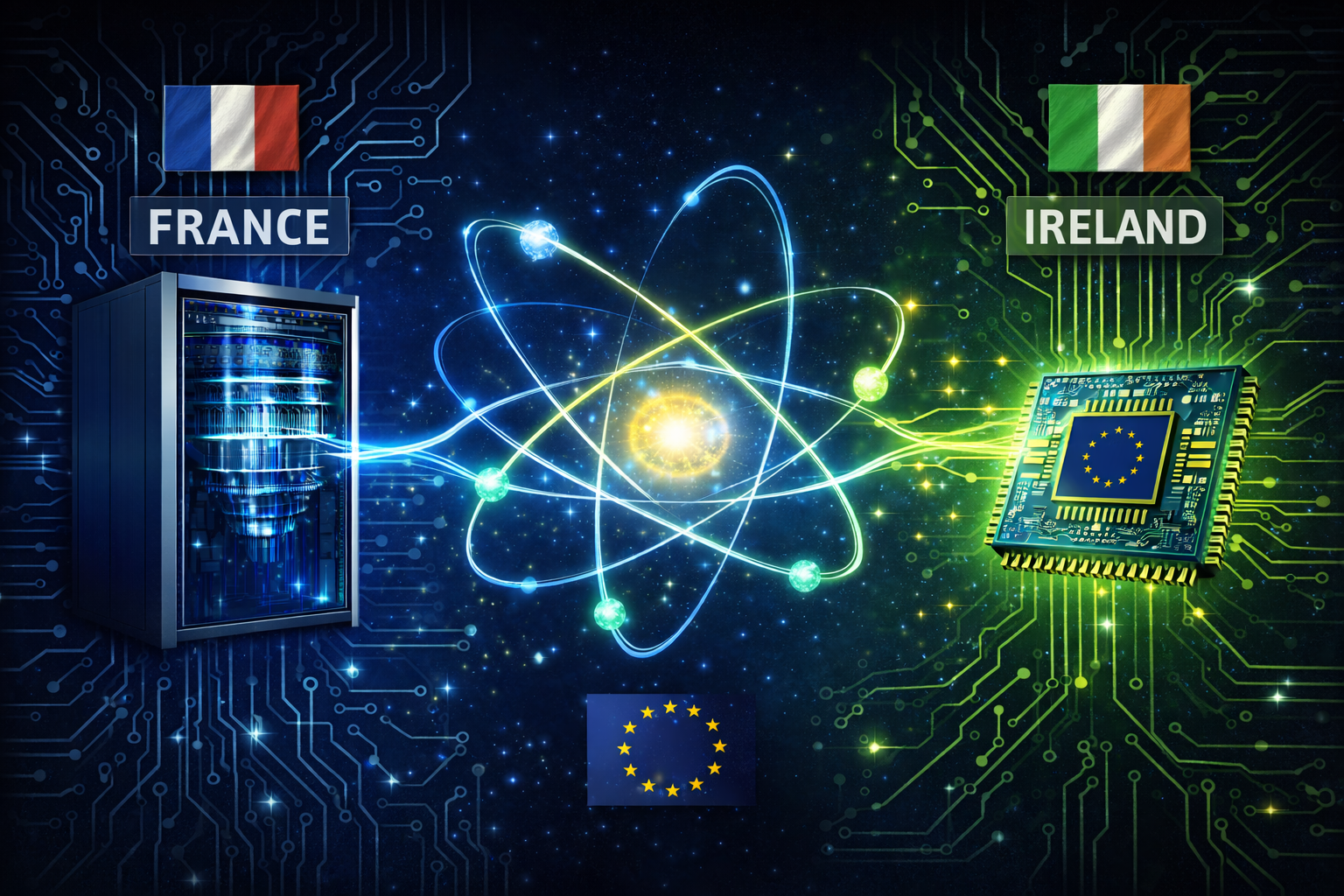
On Quantum Day 2026, France and Ireland are quietly advancing a shared quantum agenda — from Lucy's inauguration in Paris to Equal1's deployable hardware in Dublin. Here is what the bilateral ecosystem looks like today.
Every 14th of April, the global scientific community marks World Quantum Day. The date is not arbitrary: it derives from the opening digits of Planck's constant, 4.14… × 10⁻¹⁵ eV·s — the number that, at the turn of the twentieth century, cracked classical physics wide open. For years, the occasion was primarily educational: a chance to explain superposition, entanglement and quantum gates to an audience that was curious but still distant from any real industrial stakes.
In 2026, something has shifted. And on this particular 14th of April, that shift became impossible to ignore.
On the very day the quantum community was marking the anniversary, France inaugurated Lucy — the world's most powerful photonic quantum computer — at a national supercomputing facility outside Paris. On that same day, in Dublin, Bull and Equal1 signed a formal collaboration agreement, linking France's sovereign computing infrastructure directly to Ireland's most pioneering quantum hardware company. Two events, two cities, one continent — and a single unmistakable signal.
A coincidence of timing? Hardly. It was a statement. And it is one chapter in a much larger story that connects, in ways that are increasingly concrete, the scientific and industrial ecosystems of France and Ireland.
The bigger picture: quantum as strategic infrastructure
To understand what is happening, it helps to step back from individual announcements and look at the pattern they form.
For most of the past decade, quantum computing occupied a particular rhetorical space: endlessly promising, perpetually ten years away, and largely confined to academic papers and conference keynotes. That characterisation is no longer accurate — and the change has not happened overnight, but through a steady accumulation of decisions, investments and deployments that, taken together, amount to a genuine phase transition.
The most significant of these decisions, in recent months, has been the French state's move to take back direct control of Bull — the high-performance computing division formerly held within Atos and its subsidiary Eviden. This is not primarily an industrial rescue operation. It is a declaration of principle: that certain computing infrastructures have become too strategically important to be governed solely by market logic. Defence, climate modelling, drug discovery, financial risk, energy grid optimisation — all of these domains now depend on computing capacity that, if controlled by external actors, would represent a systemic vulnerability. France has decided that sovereign control over that capacity is non-negotiable.
Quantum computing, in this framing, is not a separate technology. It is the next layer of a computing continuum that already includes classical high-performance computing and artificial intelligence. Lucy, inaugurated on Quantum Day, is the most visible embodiment of that conviction.
And French President Emmanuel Macron has been explicit about the ambition: to make Europe a quantum power — not merely a quantum research hub, but an entity capable of competing on industrial terms with the United States and China. In 2026, that ambition is no longer rhetorical. It is beginning to show up in balance sheets.
Lucy: a sovereign quantum computer, freely accessible to Europe
Lucy deserves more than a passing mention, because it represents something genuinely new in the European landscape.
Built by French quantum startup Quandela — a company spun out of France's national research centre — with cryogenic systems from its German partner Attocube, Lucy was procured by the EuroHPC Joint Undertaking through France's national high-performance computing operator, and co-funded under France's national quantum strategy. Every component in its supply chain is European.
It now sits at the Très Grand Centre de Calcul (TGCC) — France's largest national supercomputing facility, operated by the CEA, France's civil and military research agency — where it is coupled to the Joliot-Curie supercomputer. This hybrid architecture is central to how Europe thinks about quantum integration: quantum processors functioning as specialised accelerators alongside classical supercomputers, rather than as standalone machines requiring their own dedicated facilities. In 2027, Joliot-Curie will be replaced by Alice Recoque, a planned European exascale supercomputer combining HPC, AI and quantum capabilities in a single infrastructure.
What makes Lucy particularly significant is its underlying technology. Photonic quantum computing — which uses particles of light rather than superconducting circuits — does not require processors cooled to near absolute zero. This makes photonic systems considerably easier to integrate into standard data centre environments. Lucy is, in a meaningful sense, a quantum computer designed to behave like infrastructure. And it is now freely accessible to European researchers and companies working on problems ranging from logistics optimisation to molecular simulation and materials science.
France's quantum portfolio: depth through diversity
Lucy is not a standalone achievement. It sits within a broader French quantum strategy — launched in 2021 with initial funding of €1.8 billion — that is now entering an explicitly industrial phase.
What distinguishes France's approach is a deliberate technological diversification. Rather than concentrating resources on a single approach, France has backed multiple parallel bets. The reasoning is straightforward: no one yet knows which quantum technology will prove dominant at industrial scale. Rather than pick a single winner, the strategy is to maintain credible positions across all the leading approaches — and let the market and the science decide over time.
Pasqal represents the most visible commercial success of this strategy. In 2026, it became France's first quantum unicorn — raising €340 million and reaching a valuation approaching €2 billion, with a stock market listing now under active consideration. Its neutral-atom quantum computers represent a distinctive technological approach, and its commercial trajectory is beginning to convince investors and customers well beyond the specialist community.
Alice & Bob addresses what many regard as the most fundamental challenge in the field: error correction. Quantum systems are inherently noisy — qubits are fragile, and small perturbations accumulate into computational errors that can render results meaningless. With more than €100 million raised, Alice & Bob is pursuing a specific approach to building qubits that are inherently more stable, reducing the overhead required for error correction. This work is directly connected to France's PROQCIMA programme, which has set a concrete national target: a fault-tolerant quantum computer — one capable of correcting its own errors in real time — by 2030. That target provides a planning horizon that both public and private actors can orient themselves around.
Quandela, beyond Lucy, has built a broader commercial strategy around accessibility. Its quantum computers are available via the cloud; its open-source quantum programming framework has a growing community of users; and its MerLin environment — designed to make quantum machine learning accessible to data scientists without requiring physics expertise — will be available on European cloud platform OVHcloud from mid-2026. Quandela was also recognised with the DIGITALEUROPE Future Unicorn Award 2026, reflecting its deployment of five quantum computers across Europe and North America and the launch of Europe's first open-source quantum cloud.
Quobly is pursuing silicon-based qubits — an approach whose strategic logic lies in compatibility with existing semiconductor manufacturing chains. If successful, it would allow quantum computing to scale not by building new factories from scratch, but by integrating quantum elements into production lines that already exist and already work.
And then there is C12 — perhaps the least visible of this cohort, but pursuing one of the most radical approaches: qubits built from carbon nanotubes. Operating from purpose-built underground facilities engineered to achieve the vibrational and electromagnetic isolation its experiments require, C12 embodies the conviction that the fundamental materials question in quantum computing is still genuinely open. Its work is a reminder that France's technological diversification operates all the way down to the physics of matter itself.
Taken together, these five companies cover the principal technological approaches in the field: neutral atoms, error-correcting qubits, photonics, silicon and carbon nanotubes. This is not a competitive landscape. It is a portfolio — and it is a deliberately constructed one.
Cybersecurity: the first quantum market that is already here
Before turning to Ireland, it is worth pausing on an aspect of the quantum transition that receives less attention than computing hardware, but is arguably more immediately consequential for business: post-quantum cryptography.
The threat is real and the timeline is compressed. Quantum computers sufficiently powerful to break current encryption standards would render a large proportion of today's secure communications vulnerable. This includes not just future communications, but data that adversaries are already collecting today with the intention of decrypting it later — the so-called "harvest now, decrypt later" attack vector. Sensitive industrial data, medical records, financial transactions, government communications: all of these are potentially exposed.
The response is not to wait for quantum computers to arrive before acting. It is to begin migrating to encryption standards that are resistant to quantum attack now. This is precisely what Orange Business and Cisco are doing, with the commercial deployment of post-quantum cryptography (PQC) networks — a development that is directly relevant to Ireland's financial services sector, its pharmaceutical industry and its large technology company ecosystem, all of which manage sensitive data at European scale.
Alongside this, programmes are advancing — including through the European Space Agency — on quantum cryptography via satellite: systems that would use quantum entanglement to create communications channels that are physically impossible to intercept without detection. This is not science fiction. It is a funded research programme with defined milestones, at the intersection of telecommunications, cybersecurity and critical infrastructure.
For Irish decision-makers, the practical implication is straightforward: the first quantum revolution to affect your organisation will almost certainly be in security, not in computing. And it is already underway.
EuroHPC: the shared infrastructure that connects it all
The context within which both French and Irish quantum developments are unfolding is provided by the EuroHPC Joint Undertaking — the EU initiative that pools resources across member states and private partners to build a world-class supercomputing ecosystem in Europe.
The scale of what EuroHPC has assembled is worth stating plainly. Across Europe, there are now 14 world-class supercomputers operating under its framework, adding more than 3 ExaFLOPs of computing power to the European research and innovation environment. But for the quantum story specifically, the more significant figure is this: 10 quantum computers have already been integrated into European supercomputers, using 6 different technologies developed by European companies. Lucy is the fourth to be inaugurated. EuroHPC has not picked a technological winner. It has created a continent-scale testbed for quantum integration — and the results are beginning to be used.
Beyond hardware, EuroHPC supports 19 AI Factories and 13 AI Factory Antennas, providing compute time and sector-specific services to European startups and SMEs. France's national AI Factory, operated through GENCI — France's Grand Équipement National de Calcul Intensif, the public operator responsible for the country's national HPC infrastructure — is being designed with an explicitly quantum-ready architecture, meaning its systems are built today to accommodate quantum accelerators alongside AI accelerators as they become available. Critically for the bilateral story told in this article, Ireland is set to join this network directly: the launch of an Irish AI Factory Antenna is expected within days. This Antenna will be operationally coupled with the French AI Factory, creating a live institutional link between GENCI's infrastructure in France and Ireland's emerging quantum and AI ecosystem — translating what has until now been a strategic ambition into a concrete, funded, operational connection.
Ireland's broader connection to the EuroHPC ecosystem is also set to deepen through CASPIr — a new national supercomputer to be hosted at ICHEC, the Irish Centre for High-End Computing. A call for expressions of interest has just been launched. When operational, CASPIr will be Ireland's node within the EuroHPC network: the national gateway through which Irish researchers, universities and companies will access the full range of European high-performance computing resources, including quantum systems. ICHEC already serves as Ireland's national HPC centre; CASPIr will expand both its scale and its connectivity to the wider European infrastructure. This is not a peripheral development. It is the infrastructure foundation on which Ireland's quantum ambitions will be built — and it places Ireland squarely within the same continental computing ecosystem as Lucy, Alice Recoque, and the quantum computers running at supercomputing centres across Europe.
Ireland's quantum ecosystem: integration as strategy
Within this broader context, Ireland has developed a quantum strategy that is distinctive in its approach but highly complementary to what France is building.
Ireland is not attempting to cover the full quantum value chain. Its strength lies elsewhere: in positioning precisely at the points of convergence where an emerging technology meets existing infrastructure, markets and expertise. And it is at exactly those convergence points that the most consequential work in quantum is happening right now.
The most illustrative example is Equal1, a Dublin-based company that has built a quantum computing technology specifically designed for data centre integration. In January 2026, Equal1 raised $60 million in a funding round that brought its total financing to approximately $85 million. More importantly, it marked a transition from development to deployment: Equal1 is no longer a startup proving its concept. It is a company beginning to ship product.
That product — the Bell-1 quantum server — is rackable, plug-and-play, draws approximately 1.6 kW of power, and can be installed in existing data centre environments without significant reconfiguration. It does not ask industry to adapt to quantum computing. It adapts quantum computing to industry. This design philosophy echoes, from a different technological direction, exactly what Lucy represents in the French context: quantum as a component of infrastructure, not as an object of spectacle.
Equal1 has been selected by the European Space Agency to develop a hybrid quantum computing system under the Φ-lab programme — testing quantum approaches on genuinely operational problems: Earth observation data processing, satellite mission optimisation, large-scale climate modelling. The fact that the ESA — an organisation whose primary mission is spaceflight, not technology promotion — has integrated quantum into its operational research agenda is a credibility signal that no academic paper can replicate.
The QUBIC project, funded at €13.7 million, illustrates a complementary logic. Its architecture is deliberately integrative: quantum hardware from Equal1, applied AI research from CeADAR — Ireland's national centre for applied AI — industrial infrastructure from Dell Technologies, and sector-specific applications from partners including Biosimulytics. In pharmaceutical research, Biosimulytics is exploring how hybrid quantum-classical approaches might accelerate molecular discovery — a domain where the economics are stark: developing a single drug costs on average more than a billion dollars and takes over a decade. Even a marginal improvement in simulation capability has enormous potential value.
CeADAR's role in QUBIC is worth noting specifically, because it points to a convergence that will define the next phase of quantum development: the intersection of artificial intelligence and quantum computing. The same convergence is visible in Quandela's MerLin environment in France, and in the quantum-ready design of GENCI's AI Factory. Ireland and France are arriving at this intersection from different directions — one through applied research and industrial pilots, the other through sovereign infrastructure — but they are arriving at the same place.
Private capital: a signal of industrial maturity
One dimension of the quantum transition that tends to be underweighted in technology narratives is the shift in the nature of financing. Public investment built the foundations; the question is whether private capital has begun to take over the role of driving scale.
The answer, increasingly, is yes. The launch by Quantonation of a €220 million fund dedicated exclusively to quantum technologies is a particularly clear signal. This is not a bet on a single company. It is a thematic bet on an entire sector — an expression of the view that quantum, in aggregate, has reached a level of maturity sufficient to justify long-term sector exposure. Several observers have drawn comparisons to the position semiconductors occupied for specialist investors thirty years ago: a deep-technology domain with long development cycles, high barriers to entry and the potential for structural impact on multiple industries simultaneously.
When private capital begins to reason in these terms — and when that reasoning attracts €220 million in a single fund — the dynamics of talent attraction, company formation and industrial commitment change with it. It is a self-reinforcing signal, and it matters.
A natural Franco-Irish partnership
Stepping back, the complementarity between the French and Irish quantum ecosystems is striking — and it is worth articulating clearly, because it is not accidental.
France brings depth: a diversified portfolio of hardware companies spanning five distinct technologies; a national computing infrastructure that is integrating quantum at scale; a programme (PROQCIMA) with a defined technical target for 2030; a private investment ecosystem (Quantonation) capable of backing the sector for the long term; and a political commitment, articulated at the highest level, to European technological sovereignty — including through GENCI's AI Factory, which is being deliberately architected as quantum-ready and is now directly linked to Ireland through the imminent launch of the Irish AI Factory Antenna.
Ireland brings agility: a national computing infrastructure (ICHEC, and soon CASPIr) positioned within the European EuroHPC network; a hardware company (Equal1) whose design philosophy makes quantum practically deployable in industrial environments today; a project (QUBIC) that demonstrates the full value chain from physics to application; and sector depth — in pharmaceuticals, financial services and technology — that provides exactly the kind of high-value application domains where quantum will generate its most significant early returns.
The partnership announced on Quantum Day 2026 between Bull and Equal1 is the most direct expression of this complementarity. It connects France's sovereign computing capacity with an Irish technology designed for industrial deployment. Neither party is subordinate. Each brings something the other cannot easily replicate. That is what a genuine strategic partnership looks like.
What changes in 2026: status, not just performance
The deepest shift happening in quantum computing right now is not a performance breakthrough. Quantum systems are improving, but the gains are incremental. What is changing is something more fundamental: the status of quantum technology.
A technology treated as a research object attracts research funding, produces papers and generates demonstrations. A technology treated as infrastructure attracts long-term capital investment, stable policy frameworks, industrial procurement decisions and workforce development programmes. The latter is a self-reinforcing dynamic. Once it begins, it is very difficult to reverse.
In 2026, the signals that quantum has crossed that threshold are accumulating. France's first quantum unicorn has been valued at close to €2 billion. A world-class quantum computer is freely accessible at a national supercomputing facility. Post-quantum cryptography is being deployed commercially by major telecoms operators. A quantum server fits in a standard data centre rack. A €220 million fund is betting on the sector as a whole. A national programme has committed to fault-tolerant quantum computing by 2030. An Irish AI Factory Antenna is about to go live, operationally coupled to France's quantum-ready national AI infrastructure. And Ireland is preparing the broader computing foundation — through CASPIr and ICHEC — to be a full participant in the European quantum ecosystem as it reaches operational scale.
None of these developments, taken individually, constitutes a revolution. Together, they constitute a change of phase.
Conclusion: the accumulation that changes everything
Quantum computing will not announce its own arrival. There will be no single morning when the technology is suddenly everywhere, no press conference declaring the transition complete. That is not how deep technological transformations work.
They work through accumulation. Proof of concept becomes pilot. Pilot becomes deployment. Deployment becomes standard. And at some point — usually later than the optimists predicted and earlier than the sceptics assumed — the accumulated decisions of thousands of researchers, engineers, investors and policymakers have quietly built something that was not there before.
In 2026, that accumulation has reached a point of coherence that was not visible even two years ago. The pieces are connecting: sovereign infrastructure and deployable hardware; AI integration and quantum-ready architectures; post-quantum security and long-term private capital; national programmes with defined targets and bilateral partnerships with real projects. And now, with the Irish AI Factory Antenna about to launch in direct operational partnership with GENCI's French infrastructure, that coherence has an institutional expression that is both concrete and durable.
Ireland and France are not waiting for quantum computing to mature before engaging with it. They are participating in its maturation — each from a position of genuine strength, each contributing something the other cannot provide alone. That is the most productive form of international cooperation in deep technology: not dependency, but complementarity.
Europe is not behind in this race. It is running a different race — one defined less by speed to market than by the depth and resilience of the ecosystem being built. The returns from that approach are slower to materialise. But in a domain as technically demanding and as strategically consequential as quantum computing, they are likely to be more durable.
And in quantum physics, as in quantum strategy, it is often the least spectacular phenomena — the gradual, the distributed, the cumulative — that produce the most lasting effects.