

/
10 min read
While Europe was on holiday, the AI infrastructure race moved up a gear
What the summer's AI Gigafactory call means for Europe, France and Ireland
Back to work today. So, what happened in Europe while we were away this summer?
Quite a lot, actually. And one thing in particular got far less attention than it deserved. On 30 July 2026, the European Commission and the EuroHPC Joint Undertaking opened a call for tenders to build up to seven AI Gigafactories across the European Union. It landed in the dead weeks of late July, up against holidays and out-of-office replies, and it slipped past most people. I suspect it will turn out to be one of the more important European technology decisions of the year.
To see why, it helps to put the announcement to one side for a moment and look at what Europe is really trying to build.
The race is now about infrastructure, not just ideas
For most of the last decade, the AI story was told through algorithms, models and talent. Whoever had the cleverest researchers and the best architectures would win.
That framing no longer holds on its own. Competitiveness in AI now rests on a set of things that are far more physical and far more expensive: compute, data, energy, skills, infrastructure and capital. You cannot train a frontier model without huge quantities of specialised processors, the electricity to run them, and the cooling, networking and storage to keep the whole thing alive.
Europe has spent several years building its own answer to this through the EuroHPC Joint Undertaking, a partnership that pools money from the EU and participating states to fund high-performance computing (HPC). It has already procured twelve supercomputers, among them JUPITER in Germany and Alice Recoque in France, Europe's first exascale-class systems. The AI Gigafactory call is the next, much bigger stage of the same effort.
Before going any further, it is worth untangling three terms that get confused constantly, because they really do describe different things.
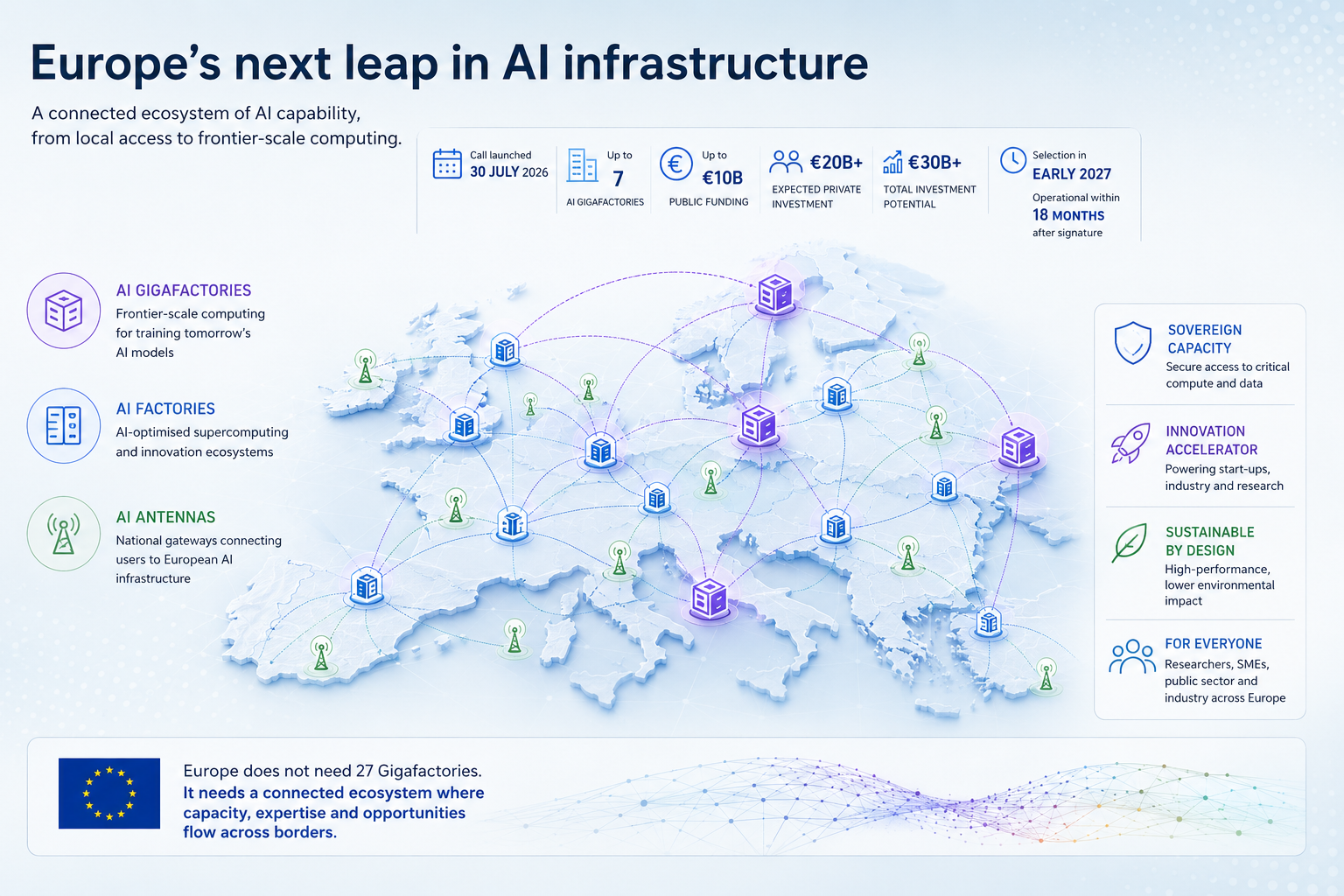
An AI Factory Antenna does not necessarily run its own large AI supercomputer. It works as a national or regional gateway into the wider European AI ecosystem. It gives local companies, start-ups, researchers and public bodies access to computing resources hosted elsewhere, plus technical expertise, training and help with developing and optimising models. The whole point is to let a country without its own large-scale AI infrastructure take part fully in the European network.
An AI Factory combines an AI-optimised supercomputer with an ecosystem of services, data, expertise and users. The Commission currently counts 19 AI Factories across Europe, plus 13 AI Factory Antennas. And an AI Factory is not just a supercomputer. It is meant to wrap the hardware together with software, datasets, training and hands-on support, so that researchers, SMEs and start-ups can reach capabilities that would otherwise belong to a handful of very large tech firms.
An AI Gigafactory is the next size up. The Commission describes these as facilities that could hold more than 100,000 advanced AI processors, along with everything that implies: electricity, cooling, networking, storage, data infrastructure, resilient supply chains, software, automation and technical expertise. The tender itself sets hard thresholds. Medium-scale facilities have to reach at least 75,000 accelerators in H100-equivalent terms, large-scale ones at least 100,000.
A rough way to keep the three straight:
Antenna, an access point and services. Factory, AI-optimised supercomputing plus an ecosystem. Gigafactory, very large-scale infrastructure for frontier models.
These are not three rival programmes. They are connected layers of the same emerging European AI infrastructure.
What happened on 30 July
The Gigafactory call opened on 30 July 2026, with a submission deadline of 12 November 2026, 16:00 CET. EuroHPC then evaluates the bids, award decisions are expected in early 2027, contracts follow, and the selected facilities are meant to be operational within eighteen months of signature at the latest.
The financing is where it gets interesting. The initiative is backed by up to €10 billion in public European and national funding, and is expected to pull in at least €20 billion in private investment, which takes the potential total past €30 billion across the Union. Eighteen member states, France and Ireland among them, have signed a joint procurement agreement to make it happen.
What sets this apart from an ordinary grant scheme is the mechanism. EuroHPC and the participating states will not only put money in at the start. They will also jointly buy computing access time from the selected Gigafactories. Public authorities, in other words, are committing to become customers. This anchor-customer model matters because it takes the edge off the enormous upfront risk. If you are trying to raise several billion euros for a facility, a credible promise that governments will buy a real slice of its output changes the whole calculation.
Why this is strategic, not just expensive
It would be easy to file all this under "big European funding announcement" and move on. That would be a mistake.
Access to very large-scale compute has become strategic for a long list of reasons. Training and fine-tuning frontier models. Running inference at scale. Scientific and industrial AI. Sovereign and secure data processing. Giving European start-ups somewhere to grow. Reducing the reliance on a small number of non-European hyperscalers. Underneath all of it sits one central question.
Can Europe be a serious AI power if its own researchers and companies end up depending on computing infrastructure that sits, or is controlled, somewhere else?
The Gigafactory programme is one part of the Commission's wider AI Continent Action Plan, which wants Europe to be a place where advanced AI gets built on European infrastructure, under European rules on data protection, safety, security and ethics.
None of this is easy. Gigafactories eat electricity, lean on advanced chips whose supply is anything but guaranteed, and need serious cooling. They sit right where AI policy, industrial policy, energy policy and economic sovereignty collide, which means they inherit the tensions of all four at once. Enthusiasm is warranted, but so is realism: building and powering infrastructure at this scale is a substantial undertaking.
France: from Factory to Gigafactory
France has moved fast. It already hosts AI Factory France (AI2F), part of the EuroHPC network and built around the country's HPC strategy, with Alice Recoque at its centre. Alice Recoque is Europe's second exascale supercomputer, owned by EuroHPC, hosted and run by the France-led Jules Verne consortium through GENCI and CEA at CEA's site in Bruyères-le-Châtel, with a total budget of around €355 million and installation now underway.
Alongside the European call, France made a pointed move. The government said it would order roughly €100 million of computing capacity from whichever Gigafactory ends up being selected on French soil, to cover the future needs of its public administrations, including research and hospitals.
This is worth dwelling on. The French state is not just writing a subsidy cheque. By committing to buy compute, it becomes an anchor customer and creates guaranteed early demand for infrastructure that does not yet exist. That guaranteed demand makes the project easier to finance, and it points to something bigger: an industrial policy in which public purchasing itself becomes a way to build European AI capacity. Governments have always used their buying power to shape markets. Pointing it at AI compute is a real shift.
The consortium race
Two French-led initiatives have said publicly that they intend to bid, and it is worth being precise about their status. Both have announced candidacies. Neither has been selected, and nothing gets decided until 2027.
AION is the more visible of the two. Led by Iliad's cloud arm Scaleway, it has reportedly put forward a roughly $10 billion, 200-megawatt facility built around next-generation GPU clusters, described as the equivalent of more than 288,000 current-generation Nvidia H100s. Its backers read like a tour of the French AI stack: capital from Ardian, industry and energy from EDF, Iliad and Orange, IT services and consulting from Capgemini, Sopra Steria and Artefact, compute and chips from Atos (Bull), SiPearl and VSORA, model labs and platforms including Kyutai, H Company, Hugging Face and LightOn, with operational support from GENCI and Inria, the co-leads of AI2F.
ÆTHER, unveiled on 8 July 2026, takes a Strasbourg-centred, cross-border route. Led by the HPC server maker 2CRSi, its thirteen founding members include Dassault Systèmes (through its OUTSCALE sovereign-cloud brand), SiPearl, the Dutch inference-chip specialist Axelera AI, Viridien, Électricité de Strasbourg, Equans, Socomec, Haffner Energy, Demathieu Bard, Nhood and Projex. The consortium says it is in advanced talks to buy two industrial sites near Strasbourg, aiming for around 42 MW of capacity at the start and more than 400 MW eventually, subject to what the grid can handle.
Look past the logos and the interesting part appears. A working Gigafactory needs several things at the same time: capital, electricity, HPC, cloud, chips, software, AI expertise and customers. No single company holds all of them. So the consortium structure is not corporate window-dressing. It is the only realistic way to assemble the full value chain behind one facility. The fact that both French bids independently reached for the same mix of ingredients tells you a lot about the shape of the problem.
Ireland: plugged in without a Factory of its own
Now cross the water. Ireland shows a different way into the same system.
Ireland does not host one of the 19 AI Factories. Instead, in October 2025 it landed an AI Factory Antenna, the AIF IRL-Antenna, awarded €10 million split evenly between EuroHPC/EU funding and national co-funding from the Department of Further and Higher Education, Research, Innovation and Science. It launched in Dublin on 1 July 2026, one of the first events of Ireland's EU Presidency.
The Antenna is led by ICHEC, the Irish Centre for High-End Computing, hosted at the University of Galway, with CeADAR, Ireland's national centre for applied AI at UCD, as core partner. Around them sits a wider ecosystem of enterprise accelerators such as PorterShed, Dogpatch Labs, RDI Hub, Republic of Work and the Advanced Innovation in Manufacturing Centre, plus digital-skills networks. The job is to give Irish start-ups, SMEs, researchers and public bodies access to advanced AI computing, expertise and training, and a way into European infrastructure they could never build alone.
The Franco-Irish link worth watching
Here is the detail that matters most if you care about the Franco-Irish innovation relationship. The Irish Antenna is directly linked to France's AI2F. That connection is meant to give the Irish ecosystem access to French AI and HPC infrastructure, and eventually to Alice Recoque itself.
It would be a mistake to reduce this to buying computing hours, though. The Irish descriptions frame it more broadly: infrastructure and data sharing, joint talent development, data spaces and federated infrastructures, and co-developing AI strategy and policy. Real cooperation between two national ecosystems, in other words. The Antenna carries a second link too, to the Luxembourg AI Factory, focused on domain-specific work across climate, environment, energy, space, smart mobility and digital health.
All of which points to a deliberate choice. Europe is not trying to build the same infrastructure in every member state. It is building a distributed network where countries specialise while sharing the very expensive resources. Ireland becomes a useful test of whether that model can give smaller states real access to frontier infrastructure without each of them spending billions on its own AI supercomputer.
What Gigafactories could change for Ireland
Looking ahead, the Gigafactories could matter for Ireland in a few ways.
The most obvious is a big jump in the European computing capacity reachable through the Factories and Antennas. And if Europe shifts from Factories towards Gigafactories, Ireland's Antenna could become more important rather than less. It would be the gateway that turns very large European infrastructure into usable services for Irish firms and researchers, across AI start-ups, software, life sciences and medtech, financial services, energy, advanced manufacturing, space, public-sector AI and university research.
There is a distinction here worth drawing out. Ireland already hosts the European headquarters and a substantial data-centre footprint of several global technology companies, which is a genuine strength. That is a different question, though, from securing dedicated compute access for indigenous firms, researchers and public bodies. The interest in European public and sovereign AI infrastructure is complementary to that existing base rather than a substitute for it.
Energy adds a further dimension. Data-centre electricity demand is already an active policy debate in Ireland, as it is in a number of member states. That opens a genuine strategic choice rather than a settled answer. Where does it make most sense for Ireland to host Gigafactory-scale infrastructure directly, and where does the Antenna model, connecting Irish innovators to capacity located elsewhere in Europe, offer the stronger route? This is a matter for Irish policymakers to weigh, and the European framework is designed to leave that choice open.
The layers of Ireland's stack
The Antenna should not be read on its own. Ireland is also procuring its next national supercomputer, CASPIr (Computation, Analysis and Simulation Platform for Ireland), a mid-range EuroHPC system of over 15 petaflops, funded 65% nationally and 35% by EuroHPC, with procurement launched in March 2026 and operation run by ICHEC. Tellingly, ICHEC is upfront that CASPIr is built for mainstream computational science and small-to-medium AI jobs, not large-scale AI workloads, for which it explicitly points users towards Europe's AI Factory supercomputers.
That honesty makes the layering clear. One reasonable way to picture Ireland's emerging stack, as layers rather than an official hierarchy: national HPC capacity through CASPIr, AI Factory services through the AIF IRL-Antenna, access to major European infrastructure through AI2F and the Luxembourg AI Factory, and, in time, frontier-scale capacity through European Gigafactories.
France and Ireland as a model of the European approach
Put together, the Franco-Irish relationship is a concrete illustration of what European technological sovereignty might mean in practice. Not every country building everything itself, but genuine interdependence inside Europe, with each partner contributing where it is strongest. France brings large-scale computing infrastructure alongside deep research and industrial capacity. Ireland brings research excellence, a strong software base, a dense ecosystem of multinational and indigenous companies, start-ups and sector-specific applications. Other member states add their own infrastructure and domain expertise. Whether this networked model becomes a lasting European advantage will depend on how well the partners coordinate, but the underlying logic is sound.
A word of caution on the numbers
One last bit of discipline. The summer also brought other big French AI announcements, including private investments unveiled around Choose France, such as Fluidstack's proposed multi-billion-euro AI data-centre project. These are real, but they are commercial data centres, not EuroHPC AI Factories, Antennas or Gigafactories. All of them answer the same underlying demand for compute. None is interchangeable with the others. Roll them into a single headline figure and you get an impressive number that means very little. Keep the categories apart.
So what actually happened this summer
So, what happened while Europe was away? Quietly, it moved another piece onto the AI chessboard.
The next phase of this contest will not be settled only by who builds the best model. It will come down to who can line up the electricity, chips, infrastructure, capital and computing capacity needed to train and run those models at scale. The Gigafactory programme is more than another funding call. It is an attempt to lay the physical foundations of a European AI ecosystem. And the link between France's AI Factory and Ireland's Antenna captures the whole strategy in miniature. Not every country has to build everything, as long as access, capacity and expertise can genuinely move across borders.
Which leaves the real question. It is no longer just whether Europe has the talent to compete in AI. It is whether Europe can build, connect and run the infrastructure that lets that talent scale.