UCD Space Strategy 2030 : Ireland Charts an Ambitious Course for Space Research and Innovation
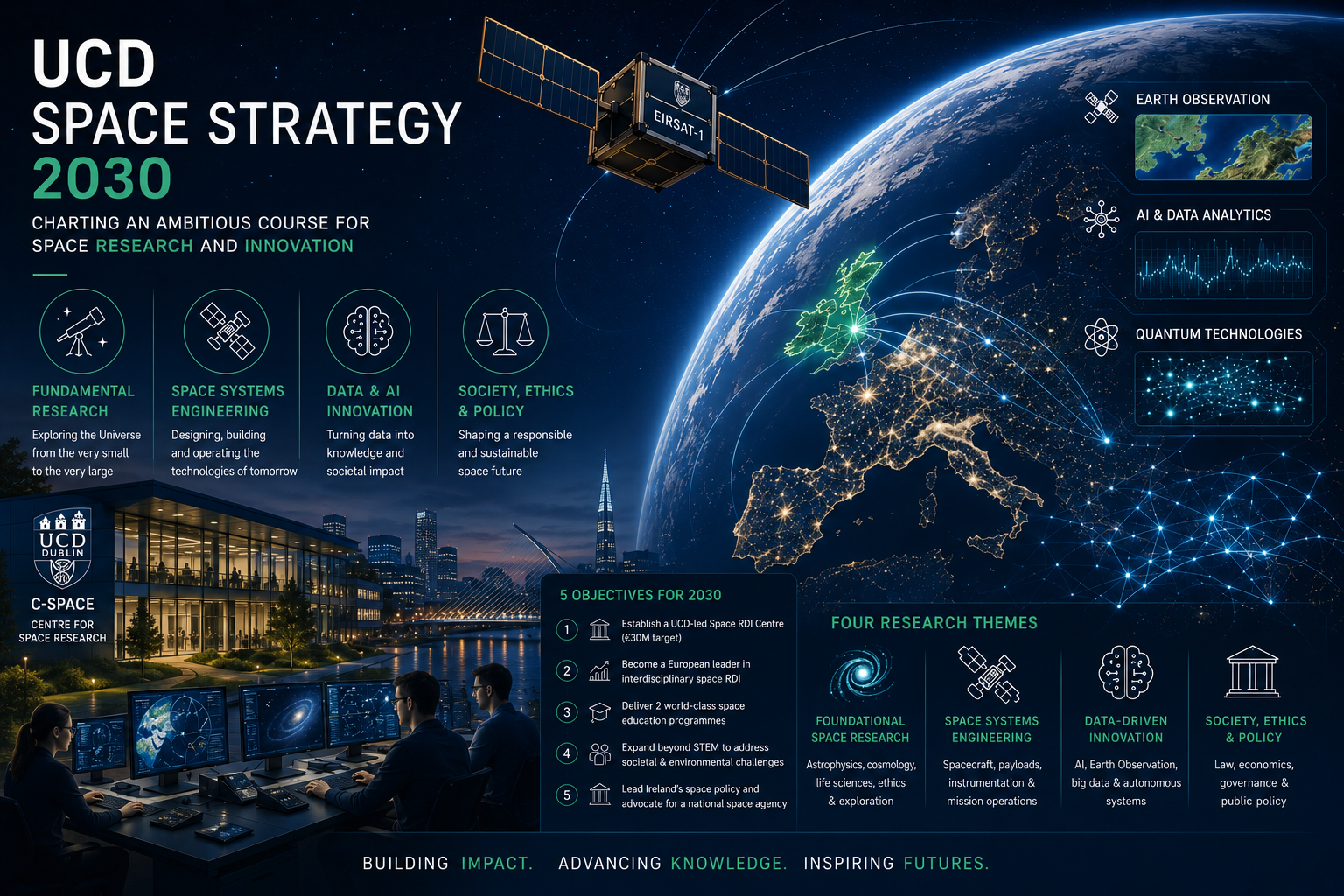

UCD has just launched its Space Strategy 2030: a blueprint that cements Ireland's place in the global space race and signals compelling new partnership opportunities for France and European actors.
I. Ireland in Space: From Participant to Co-Author
To understand the significance of the UCD Space Strategy 2030, one must first appreciate how recently Ireland entered the space age as an active participant rather than a spectator. While Ireland joined the European Space Agency (ESA) in 1975, its domestic space research and industrial capacity remained limited for decades. The country's contribution to the sector was real — Irish engineers and scientists have worked across ESA programmes, and Irish companies have carved out niches in satellite telecommunications and Earth Observation services — but a structured, institutionally anchored national space research community was largely absent until very recently.
That changed with the founding of the Centre for Space Research (C-Space) at University College Dublin in 2020. Ireland's first dedicated academic space research centre, C-Space brought together researchers from eleven schools spanning four of UCD's colleges — Science, Engineering and Architecture, Social Sciences, and Health Sciences. The cross-disciplinary composition was deliberate: the centre's founders understood from the outset that the most consequential questions in space research sit at the intersection of physics, engineering, data science, law, and policy — not within any single department.
The launch of EIRSAT-1 on 1 December 2023 gave concrete, visible form to this ambition. Built and assembled by UCD students and researchers under ESA's Fly Your Satellite! programme, Ireland's first satellite entered orbit and began generating scientific data on gamma-ray bursts — a contribution to an international detection network that would have been unimaginable for an Irish university two decades earlier. The symbolic weight was matched by institutional recognition: a communications campaign reached thirteen million people, a Dáil debate led to the adoption of a legal framework formally acknowledging the satellite, and the Higher Education Authority awarded the initiative €1 million in Performance Funding in October 2025.
EIRSAT-1 was not an endpoint. It was proof of concept — and the UCD Space Strategy 2030 is its institutional follow-on. What the document does, in effect, is convert a series of individual successes into a coherent long-term programme, with named objectives, a financial target, and an explicit claim to a role in shaping national and European space policy.
II. The Strategy: Four Themes, Five Objectives, One Direction
The UCD Space Strategy 2030 is organised around four Action Areas — Research and Innovation, Infrastructure, Education, and Leadership and Reputation — and four core Research Themes that will structure the university's scientific agenda to 2030.
Fundamental Space Sciences is anchored in C-Space's existing strengths in gamma-ray astrophysics, gravitational wave research, and space weather. This is not abstract science disconnected from application: the instrumentation, detection methods, and data analysis pipelines developed in this domain have direct relevance across the space industry, and Ireland's participation in international detection networks gives its researchers access to data and collaborations well above what a country of its size would normally command.
Space Systems Engineering covers the design, integration, and operation of spacecraft and payloads, with particular focus on small satellite platforms. The experience accumulated through EIRSAT-1 — from systems architecture through environmental testing to post-launch operations — gives UCD a practical foundation that few European universities of comparable size can claim. This is the kind of hands-on, end-to-end engineering capability that space agencies and commercial operators are prepared to pay for.
Data Innovation and AI reflects a clear-eyed recognition that the space sector's most transformative near-term opportunities lie not in launch or hardware, but in the intelligent exploitation of the data that satellites generate. UCD's broader strengths in machine learning and data science position it well to bridge the gap between Earth Observation data acquisition and actionable insight — for agriculture, climate monitoring, maritime surveillance, or disaster response. The CAMEO programme, which brings academia and industry together around Earth Observation data valorisation, is the most visible current expression of this theme.
Space Law, Ethics, and Governance is the fourth theme, and in many respects the most forward-looking. As low Earth orbit becomes increasingly congested, as regulatory frameworks for mega-constellations remain contested, and as questions of space resource utilisation move from science fiction to policy agenda, the need for rigorous interdisciplinary scholarship on space governance is becoming urgent. UCD's law school has a strong tradition of engagement with international law, and its integration within a multidisciplinary space research environment creates conditions for the kind of combined technical-legal-political analysis that these questions demand.
These four themes translate into five concrete objectives that give the document its accountability and its ambition.
Objective 1 sets the financial ambition: raise €30 million to establish a full-scale Space RDI Centre at UCD — with the infrastructure, instrumentation, and staffing to conduct sustained, internationally competitive research across all four themes. This is not a speculative figure. It reflects a costed assessment of what it takes to operate at the level the strategy envisions.
Objective 2 targets positioning: place UCD among the leading European universities for interdisciplinary space research, measurable through publications, partnerships, and participation in major ESA and EU-funded programmes.
Objective 3 addresses education: establish two internationally recognised space education programmes — at undergraduate and postgraduate level — that attract students from across Europe and beyond, and that produce graduates equipped to contribute to the space industry, public agencies, and research institutions.
Objective 4 broadens the interdisciplinary scope explicitly beyond STEM, integrating Arts, Humanities, and Social Sciences through collaborative grants addressing societal and environmental challenges. This is a deliberate signal that UCD sees space not merely as a technical domain but as a civilisational question with cultural, philosophical, and governance dimensions.
Objective 5 is perhaps the most consequential in its long-term implications: position UCD as an active driver of national space policy, contribute to key government and EU consultations, and lead advocacy for the establishment of a new Irish national space agency. Ireland is currently one of the few ESA member states without such an agency — a structural gap that limits the country's ability to coordinate its space activities, attract talent, and negotiate effectively at the European level. UCD's willingness to put its institutional weight behind this advocacy marks a significant step in Ireland's space maturation.
III. The National Architecture: NSSPI, Industry, and the Ecosystem Behind the Strategy
The UCD Space Strategy 2030 does not stand alone. It is embedded in a broader national effort to give Ireland's space sector the institutional coherence it has historically lacked — and the strategy is at its most interesting when read in that ecosystem context.
The National Space Science Programme for Ireland (NSSPI), which UCD coordinates, provides the overarching framework for Irish academic space research. It brings together universities, research institutes, and industry partners under a common strategic agenda, channelling ESA funding and national research investment towards shared priorities. NSSPI has become the primary mechanism through which Irish researchers engage with ESA's mandatory and optional programmes, and increasingly the vehicle through which Ireland makes its voice heard in European space science conversations.
The collaboration between UCD, University of Galway, DCU, DIAS, and six industry partners constitutes the full NSSPI consortium: Equal1, Mbryonics, Réaltra, Ubotica, ÉireComposites, and Altera/Intel. Together they cover the principal technology layers of a modern small satellite programme — quantum computing, optical communications, avionics, AI edge processing, composite structures, and semiconductor chips. The breadth of this industrial base is one of the more striking features of the Irish space sector for a country of Ireland's size.
Four of these companies illustrate the range of capabilities the ecosystem can now field. Equal1, a UCD spin-out headquartered at NexusUCD, brings silicon-based quantum computing hardware to the national space programme — a capability very few countries can deploy commercially at this stage. Its Bell-1 quantum computing unit has been acquired by the European Space Agency for its Frascati research centre to process Earth Observation data, making Equal1 one of the first companies globally to deliver quantum computing into an operational space context. In April 2026, Equal1 signed a memorandum of understanding with Bull — the French supercomputing company recently re-established as an independent state-owned entity — covering four axes of cooperation in quantum-classical hybrid computing. Mbryonics, founded in Galway in 2014, has built a world-leading position in photonic optical communications terminals for satellites. Its StarCom terminal is already selected for the EU's IRIS² multi-orbit constellation; its Photon-1 volume manufacturing facility in Dangan opened in September 2025 with 125 new jobs, and a second site, Photon-2, is secured in Shannon. Réaltra, a Dublin-based space electronics and avionics company, designs and manufactures cost-effective spacecraft electronics using commercial off-the-shelf components — an approach that reduces cost and lead time without compromising reliability. The company has supplied hardware for ESA missions including PLATO, and recently participated in an Irish space industry delegation to ArianeGroup and CNES in France. Ubotica, founded in 2016, develops AI and computer vision solutions for satellite edge computing, enabling on-board data processing directly on the spacecraft using Intel's Myriad Vision Processing Units — reducing the volume of data that needs to be downlinked and accelerating response times for time-sensitive Earth Observation applications.
The connection between UCD's foundational research, NSSPI's coordination role, and companies operating at the commercial frontier of quantum computing, photonics, avionics, and AI edge processing is precisely the kind of ecosystem dynamic the Space Strategy 2030 aims to systematise and accelerate.
IV. European Vectors: Science, Partnerships, and the Franco-Irish Dimension
No national space strategy makes sense in isolation from the European institutional landscape, and the UCD Space Strategy 2030 is explicitly European in its ambition and framing.
ESA's Science Programme provides the bedrock. Irish researchers have contributed to missions including Herschel, Planck, INTEGRAL, XMM-Newton, and the LISA Pathfinder, and the UCD strategy signals continued and deepened engagement with upcoming missions in the ESA Science Programme Voyage 2050 roadmap — including contributions to the Einstein Telescope and to future high-energy astrophysics missions. The Horizon Europe space cluster — and its successor framework — provides the primary mechanism for collaborative, multinational research grants that can support the interdisciplinary teams the UCD strategy envisions.
The EU Space Programme's operational components — Copernicus, Galileo, EGNOS — represent a parallel layer of opportunity, particularly for UCD's work in Earth Observation data science. Ireland has been a comparatively modest participant in these programmes relative to its economic weight; the Space Strategy 2030, by building the research capacity that feeds into European consortia, is a direct and intentional response to this gap.
Within this European landscape, the Franco-Irish dimension is among the most structurally promising bilateral partnerships available to UCD and to the Irish space sector more broadly. The complementarities are substantive, and the institutional frameworks to exploit them already exist.
In high-energy astrophysics and gamma-ray science, C-Space's demonstrated expertise connects directly with France's deep engagement in the same field — through CNRS, CEA, and a series of international missions to which French researchers have been central contributors. The PHC Ulysse bilateral mobility programme offers an immediate and underused vehicle for researcher exchanges, joint publications, and shared instrument development between Irish and French laboratories working on overlapping scientific questions.
In Earth Observation and data valorisation, UCD's CAMEO programme maps directly onto CNES priorities. France's space agency operates the Pléiades constellation, contributes centrally to Copernicus, and has built one of the world's deepest traditions of EO data exploitation — from climate monitoring and precision agriculture to maritime surveillance and crisis response. CNES's network of EO data valorisation partners represents a natural interlocutor for the Irish academic and industry community working in this space. Horizon Europe space cluster calls offer abundant ground for Franco-Irish consortium-building, combining CNES-anchored French satellite data expertise with Irish machine learning capabilities. Crucially, these conversations have already begun at industry level: Réaltra participated in a recent Irish space delegation to both ArianeGroup and CNES in Paris, a visit that opened concrete discussions on joint projects and signalled CNES's growing interest in Ireland's space industrial base.
In optical satellite communications, the complementarity extends further. Mbryonics' StarCom optical terminal technology — now entering volume production in Galway — connects directly with French interests in free-space optical communications and laser-based satellite networks. CNES has been an active contributor to optical inter-satellite link development and to the technical standards governing next-generation satellite constellations, including IRIS², in which Mbryonics' terminals are already selected for deployment. A Franco-Irish industry-to-industry cooperation in this domain, supported by shared ESA frameworks, is a natural and largely unexplored next step.
In quantum technologies for space, the Equal1-Bull MoU is the most tangible existing connection — but it points towards a wider convergence. France's national quantum strategy, backed by substantial public investment, has produced a structured ecosystem of quantum hardware startups, research institutes, and computing infrastructure operators. Ireland's quantum ambitions, anchored in Equal1 and in the CASPIr computing initiative at ICHEC, are less advanced in scale but highly complementary in technology approach. The space sector — where quantum computing's first commercial applications are now being deployed — is the natural proving ground for this cooperation.
In space law and governance, UCD's investment in this research theme connects with France's long-standing expertise in international space law. France's regulatory tradition in this domain — developed since the 2008 French Space Operations Act and expressed through active French engagement at COPUOS, the UN Committee on the Peaceful Uses of Outer Space — represents exactly the kind of doctrinal and policy experience that UCD's nascent space law programme can engage with productively.
These are not hypothetical future collaborations. They are lines of work grounded in existing scientific complementarities, active commercial partnerships, and shared European research frameworks. What they have lacked, until now, is the institutional anchor on the Irish side that the UCD Space Strategy 2030 provides.
V. What the Strategy Actually Signals — and Why September 2026 Matters
The UCD Space Strategy 2030 is, at its core, a commitment to agency. Not the passive participation that has historically characterised smaller nations in large multilateral space programmes, but a deliberate claim to co-authorship — in research priorities, in educational standards, and in the governance conversations that will shape the next decade of space activity.
That claim lands at a moment of unusual significance for European and global space policy. On 9 and 10 September 2026, Paris will host an International Space Summit at the Grand Palais — a high-level gathering of governments, space agencies, industry, and academia designed to advance cooperation on the most pressing issues facing the sector: governance of mega-constellations, spectrum management, space sustainability, and the conditions for equitable civilian use of space in an era of rising geopolitical tension in orbit. The summit is being coordinated with the support of CNES, and is expected to set the tone for European space diplomacy for the remainder of the decade.
For Ireland, this summit is both a test and an opportunity. A test, because the UCD Space Strategy 2030 explicitly commits the university to shaping national and European space policy — and such commitments must be exercised precisely in moments like this one. An opportunity, because Ireland's emerging voice in the space sector — carried by EIRSAT-1, amplified by NSSPI, and now formalised through a comprehensive institutional strategy — deserves to be heard in Paris as much as in Brussels or Noordwijk.
The specific partnership vectors identified in this article — from gamma-ray astrophysics to quantum technologies for space, from Earth Observation data valorisation to space law and governance — are not abstract proposals. They are concrete lines of work that academic researchers, industry actors, and institutional partners can begin building today, in anticipation of the conversations that September will make possible. The Paris summit will not be a bilateral event; but it will be a moment at which the quality of existing partnerships becomes visible, and at which the ambition to build new ones can be declared and acted upon.
More broadly, what the UCD Space Strategy 2030 signals is that Ireland has understood something about how influence in the space sector is actually built. It is not primarily through budget size or launch capacity. It is through scientific credibility, through niche excellence that larger actors need and cannot easily replicate, and through the ability to train talent that the entire ecosystem will eventually recruit.
Ireland's specific strengths — gamma-ray astrophysics, small satellite engineering, Earth Observation data science, space law — are not marginal contributions to a European conversation dominated by France, Germany, and Italy. They are specialisations that complement the larger programmes, and the UCD strategy is correctly framed around deepening them rather than spreading thinly across everything. The wider European context creates conditions in which a well-positioned Irish voice, anchored in strong research and credible institutional commitments, will carry disproportionate influence relative to the country's size.
Whether that potential is realised will depend less on the document itself than on the decisions that follow it: whether the €30 million materialises, whether the national agency debate moves from aspiration to policy, whether the international partnerships announced translate into joint publications, funded projects, and researchers moving between Dublin, Paris, Toulouse, and Noordwijk.
Strategies are, ultimately, only as good as their execution. But the direction is clear — and deliberately chosen. Dublin is not positioning itself as a fast follower in the European space race. It is positioning itself as an indispensable partner. That is, in the end, the most sustainable position a small, scientifically ambitious country can occupy.