/
11 min read
Tyndall 2030: Ireland's Semiconductor Flagship Sets a New Course, Opening Fresh Horizons for Franco-Irish Cooperation
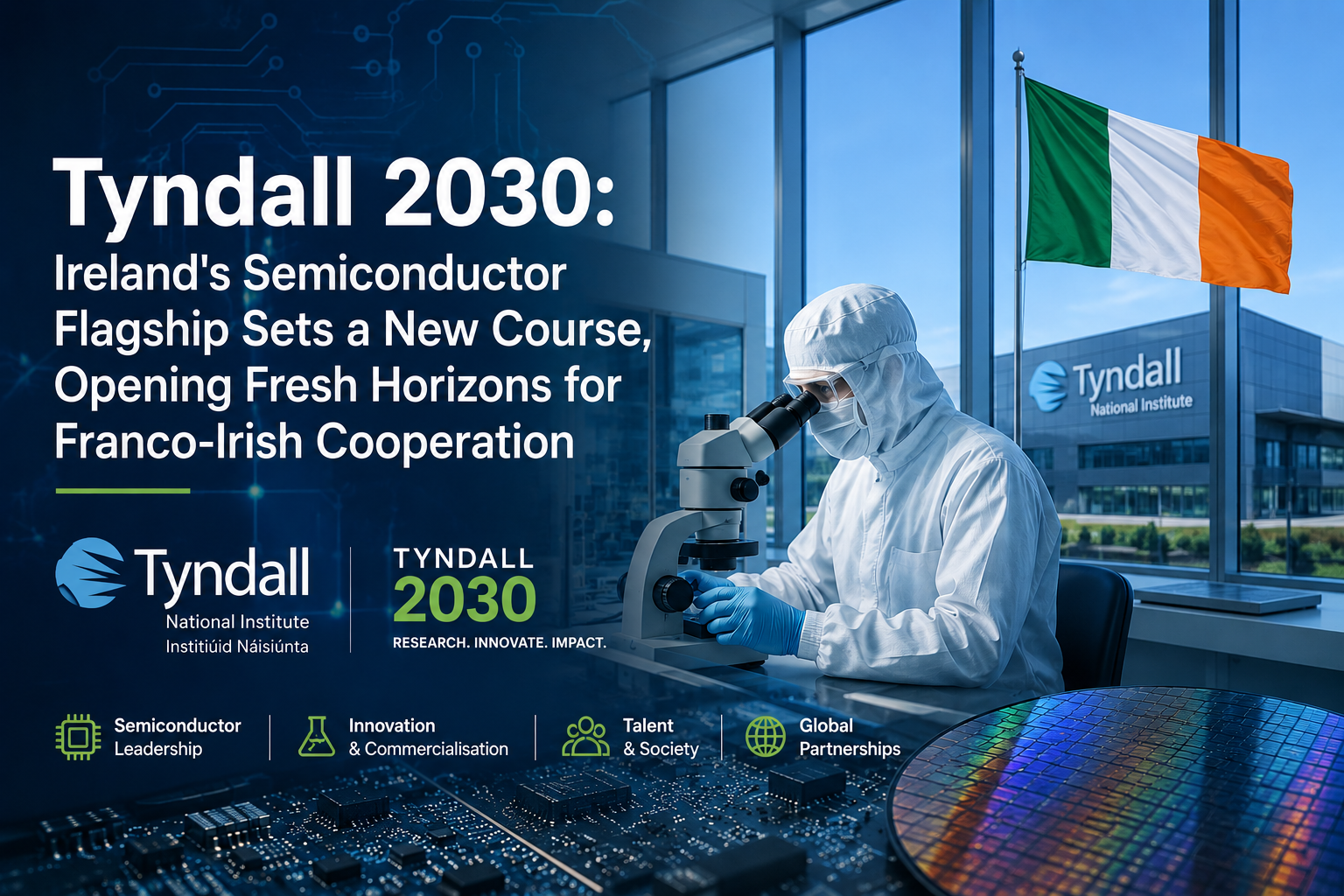
Tyndall 2030 positions Ireland at the heart of Europe’s semiconductor and quantum ambitions. Backed by major public investment and strong EU partnerships, the strategy also creates new opportunities for Franco-Irish cooperation in photonics, deep tech, talent, and industrial innovation.
1. A Strategy Launched at the Highest Level
On 25 April 2026, Taoiseach Micheál Martin travelled to Cork to officially launch Tyndall 2030, the new five-year strategic plan of the Tyndall National Institute (TNI). Flanked by Minister James Lawless TD, who oversees Further and Higher Education, Research, Innovation and Science, the Taoiseach's presence was not incidental. This was not a routine ministerial ribbon-cutting. The head of the Irish government was personally endorsing a vision, a public declaration that Ireland's future economic competitiveness will be built, in no small part, on the foundations of semiconductor science.
Accompanying the visit of French Ambassador Céline Place to Tyndall on Thursday 15 May, I had the chance to see the strategy in its natural habitat, so to speak. The document was barely three weeks old, and the conversations with CEO William Scanlon and his team still carried the energy of a recent launch: the kind of focused, forward-looking discussions that happen when an institution has just committed itself publicly to an ambitious course. What came through clearly, walking through the corridors and cleanrooms, was how much this strategy is the product of genuine conviction rather than institutional box-ticking. Tyndall knows what it is good at. It knows what Europe needs. And it has made a credible case for why those two things belong together.
Tyndall National Institute is already a serious player. Founded over 40 years ago and based at University College Cork, it is one of Europe's most respected research centres in integrated ICT, a term that covers semiconductors, photonics, quantum technologies, wireless communications, and embedded systems. Close to 700 people make up its community: staff, PhD students, and resident companies working within its infrastructure. Ask a semiconductor researcher in Korea, Japan, or the US where Europe's world-class expertise is in photonics integration or compound semiconductors, and Tyndall will come up. That reputation was earned over decades.
Tyndall 2030, though, is not simply a continuation of what came before. In the institute's own framing, it is "a step change in the role the institute will play nationally and internationally in delivering on Europe's ambitions to achieve strategic autonomy in semiconductors." The Taoiseach put it more directly at the launch: "Tyndall 2030 demonstrates that Ireland knows where it wants to be and, crucially, how to get there." For those of us working at the intersection of French and Irish innovation, this is a document worth reading closely, because the Franco-Irish dimension runs through it at several levels, some already operational and some still waiting to be fully developed.
2. Five Pillars, Concrete Targets, and a Sustainability Thread
Tyndall 2030 is built around five strategic pillars. Each one is worth looking at in some detail, because together they sketch an institution that is broadening its reach without losing its focus.
The first pillar, Research Leadership, is about maintaining a genuine frontier position in semiconductor science: materials, devices, and systems across the full technology value chain. Tyndall has real credibility here. One area worth singling out is photonics packaging and systems integration, where Tyndall holds a position that is genuinely hard to replicate elsewhere in Europe. As chips become more complex and as quantum and photonic systems move toward commercialisation, the ability to package optical components with the precision and reliability that industry demands becomes a critical bottleneck. Tyndall has spent years building that capability, and the institute is now widely recognised as a go-to partner for companies that need to bridge the gap between photonic device research and manufacturable systems. Beyond photonics, the institute holds a joint patent with Apple on power management technology for portable electronics, the result of over two decades of work on integrated magnetics and energy-efficient chip architectures by Prof. Cian Ó Mathúna's group. Major multinationals have laboratories and engineers based on-site. The 2030 strategy is not changing direction so much as reinforcing and extending it, with quantum photonics and advanced materials integration added to an already strong portfolio in compound semiconductors and sensing technologies.
The second pillar is Innovation, which in practice means closing the gap between laboratory results and industrial application, what the sector calls the "lab-to-fab" challenge. The headline targets are 10 new spin-out companies by 2030 and support for over 30 Irish SMEs in securing scale-up funding. These are not vague aspirations; they reflect a deliberate push toward commercialisation, driven both by Ireland's national semiconductor strategy and by the European Chips Act's expectation that public research investment yields economic returns. The vehicle for much of this work is I-C3 (Ireland's Chips Competence Centre), coordinated by Tyndall and co-funded by the EU Chips Joint Undertaking, which creates direct, practical pathways between Tyndall's research capabilities and the technology needs of industry, including international companies looking for a credible European research partner.
The third pillar is Infrastructure, and the numbers here are significant. The Irish government has committed €100 million to doubling Tyndall's physical footprint in Cork over the next three years, a commitment reinforced by the 2026-2030 Tertiary Sector Capital Investment Plan. New cleanroom capacity, advanced fabrication tools, and expanded metrology facilities are all in the pipeline. Walking through what already exists, the scale and organisation of the facilities are genuinely impressive for a research institute of this size. By 2030, Tyndall will be operating infrastructure that very few European open-access research centres can match.
The fourth pillar is Talent, and this is where the conversation becomes most interesting from a Franco-Irish perspective. Tyndall already hosts 50 nationalities and runs a Semiconductor Skills Programme that combines industry-led training, early career researcher development, and upskilling for engineers already in the workforce. The institute is clear-eyed about the gap between Europe's semiconductor ambitions and the pool of people needed to realise them. During our visit, this came up more than once, and so did the fact that there is currently no structured bilateral scheme between France and Ireland for researcher mobility in this field. No joint PhD framework, no exchange programme with a French engineering school, no postdoctoral pipeline. Given the depth of French expertise at CEA-Leti, CNRS, and IEMN, that gap is harder to explain than to fix.
The fifth pillar, Optimal Positioning of Ireland, covers the institute's role in European consortia, its relationships with multinationals, and its capacity to attract investment. Tyndall is a seasoned coordinator of Horizon Europe projects, and the new strategy makes clear its ambition to scale that role further, acting as an ecosystem integrator that brings together companies, universities, and research organisations around the hardest technological problems. For French actors navigating the complexity of European collaborative research, Tyndall is a well-placed partner, with both the track record and the relationships to make consortia work.
Running across all five pillars is a thread that deserves its own mention: sustainable semiconductor technology. Tyndall has spent years on energy efficiency challenges, from laptop power management to the increasingly serious problem of cooling AI chips in datacentres that run at kilowatt densities. The 2030 strategy extends this commitment into the manufacturing process itself, targeting reductions in water and chemical consumption and a genuine circular economy approach for chip materials. It is an agenda that aligns directly with European Green Deal requirements and with what French industrial partners increasingly expect from a research collaboration.
3. Silicon Island, the European Chips Act, and the Pilot Line Architecture
Tyndall 2030 does not exist in isolation. To understand it properly, you need to place it within Silicon Island, Ireland's national semiconductor strategy launched in 2023, which maps the country's ambitions across the full value chain from materials and design through fabrication, packaging, and end applications. Silicon Island explicitly includes a cross-border dimension, recognising that Northern Ireland's semiconductor industrial base (companies like Seagate, whose technologies were co-developed with Tyndall through European programmes) is part of the same story. The name is chosen deliberately.
Silicon Island also connects, increasingly openly, to a national security and resilience agenda. The context matters here: Ireland published its first ever National Maritime Security Strategy 2026-2030 in February, with the protection of critical undersea cable infrastructure listed as a strategic priority. This is precisely the kind of challenge that Tyndall has been working on, not as a policy response, but as a research programme that predates the political urgency. The institute has a team dedicated to using fibre optic cables as distributed sensing networks, capable of detecting anomalous activity along transatlantic routes. It holds an ESA-accredited space test laboratory, and Embryonics, one of its spin-outs, is already deploying laser communication systems for the space sector. Junior minister Thomas Byrne has described the government as "extremely conscious" of hybrid threats targeting critical infrastructure, and Tyndall, without seeking the label, has been building the technology to address them for years. France, identified in early 2026 as Ireland's preferred partner for its Armoured Fleet Programme, is well placed to extend that bilateral relationship into the technology resilience space where Tyndall operates.
Within the European Chips Act architecture, Tyndall's position is notable: it is a hosting partner in three of the five Chips Act pilot lines, a distinction shared by very few institutes in Europe. Minister Lawless himself highlighted this in late 2025 as "a major achievement for Irish semiconductor research."
FAMES (Fabrication of Advanced Microelectronics for a Sustainable Europe) is the first of the five Chips Act pilot lines to reach full operational status, a milestone reached in early 2026. Coordinated by CEA-Leti in Grenoble, it brings together imec, Fraunhofer, VTT, CEZAMAT, UCLouvain, Silicon Austria Labs, SiNANO Institute, Grenoble INP-UGA, the University of Granada, and Tyndall. The focus is on FD-SOI technology, RF, embedded non-volatile memories, 3D integration, and power management ICs: technologies that underpin IoT, 6G networks, and energy-efficient systems. FAMES is, at this point, the most institutionalised expression of the Franco-Irish semiconductor partnership. CEA-Leti leading the consortium with Tyndall as a hosting partner means there are already engineers from Cork and Grenoble working on the same problems, week in and week out.
NanoIC is the €2.5 billion beyond-2nm pilot line, hosted by imec and co-developed with CEA-Leti alongside Fraunhofer, VTT, CSSNT, and Tyndall. Tyndall's contribution centres on the integration of emerging materials (transition metal dichalcogenides and oxide semiconductors) into next-generation integrated circuits. This materials integration work is one of the genuine bottlenecks in Europe's path toward sub-2nm chips, and Tyndall's expertise is a valued and specific contribution to a consortium that could otherwise look rather similar to its predecessor programmes.
PIXEurope is the Chips Act pilot line for advanced photonic integrated circuits, coordinated by ICFO in Barcelona with a mobilised investment of around €400 million. Tyndall, through Prof. Peter O'Brien's photonics packaging group, leads the development of packaging technologies and plays a central role in the prototyping and technology transfer gateway. It is the clearest institutional expression of Ireland's unique position in photonics packaging at European scale.
Beyond the three Chips Act pilot lines, Tyndall also hosts the Irish chapter of P4Q (Photonics for Quantum), a separate €50 million Chips Joint Undertaking initiative launched in early 2026 across twelve countries and coordinated by the University of Twente. Its mission is to create the manufacturing ecosystem needed to produce quantum photonic chips at scale, a critical step as the race for quantum hardware accelerates. The French presence in P4Q is substantial: CEA-Leti, Quandela, Thales Alenia Space, Thales R&T, and C2N are all consortium partners alongside Tyndall, making P4Q arguably the richest single expression of the Franco-Irish quantum photonics partnership now in operation.
4. The Franco-Irish Dimension: Solid Foundations, Real Gaps
After the visit, and reflecting on the conversations we had, the picture of the Franco-Irish relationship in this space is one of genuine existing substance alongside some gaps that are more surprising than they need to be.
The existing connections are real. FAMES alone creates daily working relationships between Tyndall and CEA-Leti engineers. NanoIC adds a second channel with the same French partner. In quantum photonics, Tyndall is a partner in EPIQUE (January 2024 to December 2026), a €10.3 million Horizon Europe Quantum Flagship initiative bringing together 18 partners from 12 countries to build a scalable photonic quantum computer. French partners in EPIQUE include CNRS, CEA (silicon photonics), and Quandela; Tyndall collaborates directly with CEA on the packaging and integration of quantum photonic components. In P4Q, the Franco-Irish connection is even richer: CEA-Leti, Quandela, Thales Alenia Space, Thales R&T, and C2N are all consortium partners alongside Tyndall, making it a genuine multilateral Franco-Irish collaboration at the quantum frontier. Beyond these projects, the ASCENT+ programme, which brought together Tyndall, CEA-Leti, imec, and Fraunhofer as an open-access nanoelectronics infrastructure for European researchers and SMEs, concluded after delivering over 100 transnational access projects; its successor activity is now embedded in the pilot lines themselves. These are working relationships built over years, not aspirational ones.
But three gaps are worth naming.
The first is talent and researcher mobility. There is no structured bilateral Franco-Irish scheme for PhD co-supervision, postdoctoral mobility, or student exchange in semiconductor-related disciplines, despite the obvious complementarity between French and Irish capabilities and despite the fact that the talent shortage is a shared problem. The PHC Ulysses mechanism, France's bilateral research exchange instrument, exists precisely for situations like this. It is underused in this sector. A bilateral programme does not require a new European framework; it requires two institutions to agree, and the goodwill is there on both sides.
The second gap is industrial connectivity. French deep-tech companies in photonics, quantum hardware, power electronics, and advanced packaging have not, in the main, found their way to Tyndall's open-access infrastructure. Part of this is visibility: Tyndall's open-access offer is less well-known among French deep-tech companies than it deserves to be, particularly compared to the more familiar Belgian and German routes into European pilot line infrastructure. Part of it is structural: there is no dedicated bilateral instrument for deep tech, equivalent to the US-Ireland or UK-Ireland R&D partnership frameworks. Enterprise Ireland and Bpifrance have the relationships to build one; the question is whether the semiconductor and quantum sector can provide the focus and urgency to make it happen.
The third gap is in security, resilience, and dual-use technologies, and it may be the one with the most untapped potential. Ireland's posture has shifted measurably. The government published its first ever National Maritime Security Strategy in February, the 2026-2030 National Development Plan allocates a record €1.7 billion in capital investment to the Defence Forces, and France has been formally identified as Ireland's preferred partner for its Armoured Fleet Programme, a bilateral relationship confirmed by Minister for Defence Helen McEntee on 24 February. In this context, Tyndall's research outputs in photonics for sensing, secure wireless communications, edge AI, and subsea cable monitoring sit in a particularly relevant position. They are civilian technologies, developed for civilian purposes, but with clear relevance to the resilience agenda both countries now share. France, through Thales and its broader technology industrial base, has the scale to make that relevance concrete. The political window is open. The technical conversation is still to be had.
5. A Partnership Worth Building
The visit to Tyndall with Ambassador Céline Place was, in a sense, a microcosm of what the Franco-Irish relationship in deep tech looks like right now: substantive conversations, genuine mutual respect, clear areas of existing collaboration, and an honest recognition that the partnership is not yet proportional to the opportunity.
Tyndall 2030 opens a five-year window. The targets (€80 million in annual income, 750 employees, 10 spin-outs, 30 SMEs supported) are not modest, and achieving them will require exactly the kind of European and international partnerships that the Franco-Irish axis is well placed to supply. France's semiconductor ecosystem, anchored at CEA-Leti, animated by a new generation of quantum startups including Quandela, Pasqal, and Alice & Bob, and reinforced by France 2030 investments, has the scale and the complementary expertise to make this partnership genuinely productive for both sides.
The practical entry points are there. The pilot lines, now operational, offer structured access for French SMEs and researchers. P4Q creates a direct Franco-Irish quantum collaboration from year one. FAMES makes every researcher who has worked in Grenoble a natural counterpart for someone in Cork. What is still missing is the bilateral connective tissue: the researcher exchanges, the industrial matchmaking events, the joint funding bids initiated from both sides rather than assembled at the last moment under European deadlines.
France and Ireland bring different but genuinely complementary strengths to this space. France has deep industrial roots in microelectronics and a strong public research base; Ireland has world-class open-access infrastructure, a proven capacity to attract and scale technology companies, and a research institute in Tyndall that holds its own against any European peer in its core fields. The European Chips Act has created a framework in which that kind of complementarity is precisely what drives the most productive consortia. And in my experience of the Franco-Irish interface over several years, the partnerships that work best are rarely the most obvious ones.
This article is written primarily for a French audience, but the invitation goes both ways. For Irish researchers, companies, and institutions looking to strengthen their connections with France's semiconductor and quantum ecosystem, whether through CEA-Leti, through the pilot lines, or through the growing community of French deep-tech companies active in photonics, quantum, and advanced materials, the Franco-Irish axis is equally worth investing in. The infrastructure, the programmes, and the political momentum are all pointing in the same direction. What remains is to act on it.
If you are a French researcher, engineer, company, or investor looking to understand what Tyndall 2030 means for your own strategy, or simply to map the Irish semiconductor and quantum ecosystem, I am happy to help. And if you are an Irish actor looking to open doors on the French side, the same applies.
