

/
6 min read
Ireland’s Space Sector Is Gaining Momentum: Growing Industrial Capabilities and Scientific Ambitions
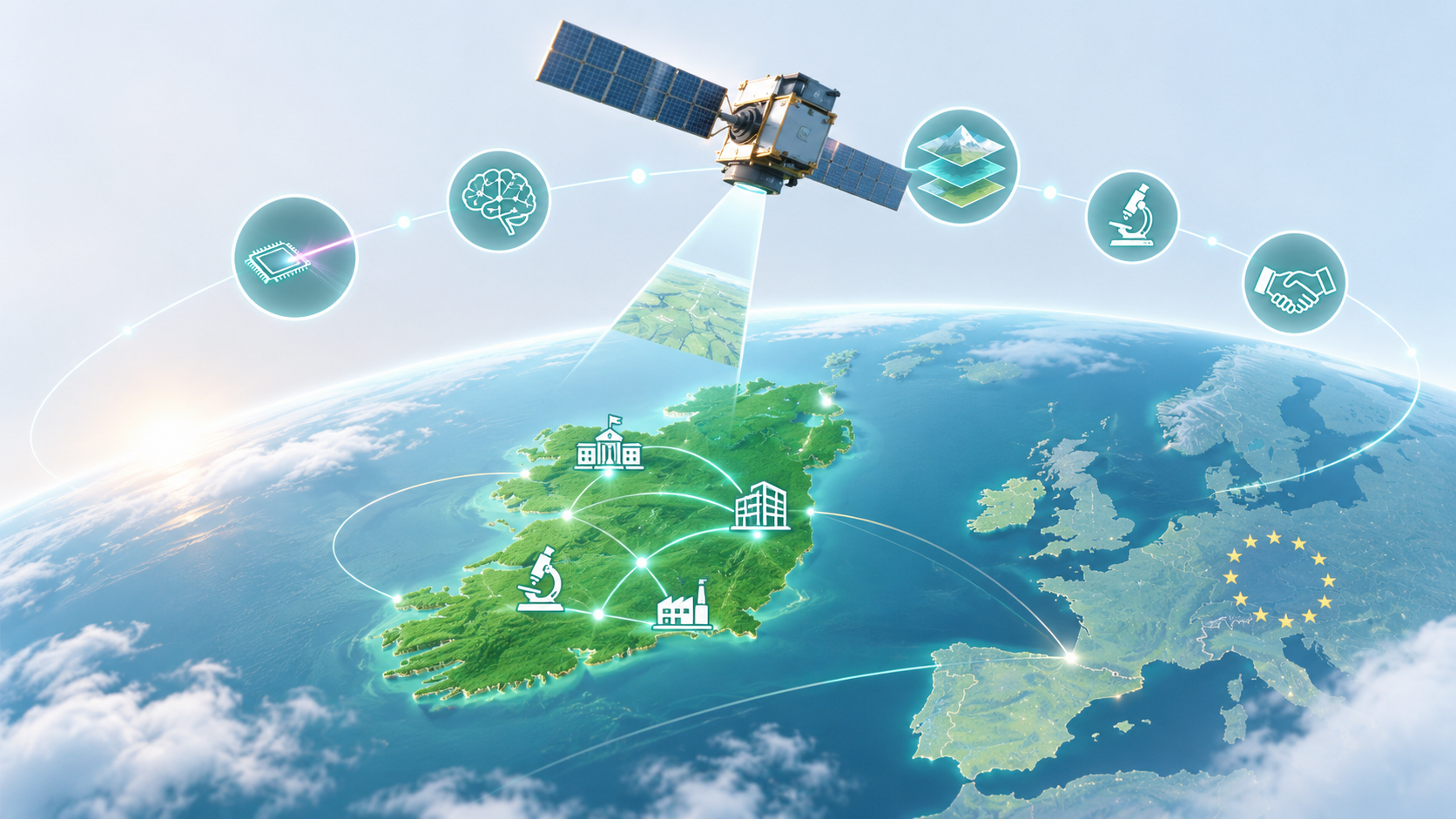
Ireland’s space sector is gaining momentum, with record ESA contracts, growing industrial capabilities and UCD’s new Space Strategy. The latest ESA report highlights an increasingly dynamic ecosystem and new opportunities for European and Franco-Irish cooperation.
The publication on 6 November of ESA and European Supported Space Activities in Ireland 2025, by Enterprise Ireland and the Irish Department of Enterprise, provides a timely opportunity to look at how Ireland’s space sector is evolving. With growing industrial activity, increased investment in European Space Agency programmes and renewed ambitions in research and innovation, Ireland is steadily strengthening its position within the European space ecosystem.
When thinking about innovation in Ireland, digital technologies, biotechnology and medical devices usually come to mind. Space is perhaps less readily associated with the country's innovation landscape, despite the emergence of an increasingly dynamic ecosystem over the past decade. Ireland does not aim to replicate the model of Europe's major space nations. Instead, it has gradually established its position by building on recognised strengths in areas such as photonics, electronics, artificial intelligence and embedded systems.
The latest report published by Enterprise Ireland provides a useful indication of how far the sector has come. In 2025, Irish companies secured €25.3 million in contracts from the European Space Agency (ESA), setting a new record following €24 million in 2024. Including contracts awarded to research organisations, the total reached €26.7 million. The number of companies actively engaged with ESA programmes has also grown to 126, including 15 new space-active entities in 2025.
These figures take on greater significance when considered alongside the decisions made at ESA's Ministerial Council meeting in Bremen in November 2025. Ireland announced an additional €40 million investment, bringing its commitment to more than €170 million for the 2026–2030 period. For a country of Ireland's size, this represents a substantial commitment. It also reflects a growing recognition that space technologies can support economic development and technological innovation well beyond the space industry itself.
Irish companies are becoming established players in major European programmes
This long-term investment is now producing tangible results. Among the companies featured in the report, Galway-based MBRYONICS offers a particularly striking example. Specialising in space-based optical communications, the company opened its Photon-1 manufacturing facility in 2025 and announced plans to create 125 jobs over two years. It is also contributing to ESA's HydRON programme, which aims to develop high-capacity optical communication networks connecting satellites and terrestrial infrastructure.
This focus on photonics is particularly relevant as the volume of data generated and exchanged in space continues to grow. Optical communications are becoming increasingly important for future satellite networks, and Ireland's scientific and industrial expertise in this field provides opportunities to contribute to major European programmes.
Other Irish companies are following equally promising paths. Ubotica Technologies is developing onboard artificial intelligence solutions that enable satellites to process data directly in orbit and respond more rapidly to changing observation requirements. Réaltra Space Systems Engineering, meanwhile, delivered equipment for ESA's PLATO scientific mission in 2025, while continuing its collaboration with ArianeGroup on camera systems for European launch vehicles.
These examples illustrate how Irish companies are moving beyond technology development to supplying components, equipment and services integrated into international space missions.
Earth observation is another area where this technological specialisation is finding practical applications. Satellite data is increasingly used in Ireland for peatland monitoring, biodiversity assessment, forestry management and precision agriculture. Companies such as Proveye demonstrate how the combination of satellite imagery and artificial intelligence can help address challenges facing the agricultural sector.
What makes these developments particularly interesting is the connection between space technologies and Ireland's wider economy. The benefits are not confined to companies manufacturing satellite components or developing onboard systems. They increasingly extend to sectors where Ireland already has established strengths and pressing environmental or economic needs.
From industrial growth to research ambitions: an ecosystem taking shape
The progress of Irish space companies is being accompanied by efforts to strengthen the research and innovation environment that supports them.
The ESA Business Incubation Centre Ireland (ESA BIC Ireland) recorded its most successful year since its establishment in 2016, signing 15 new incubation contracts. Meanwhile, the opening of ESA Phi-Lab Ireland in Mullingar in May 2025 marked another important step. Hosted by Irish Manufacturing Research, the initiative is designed to bring disruptive research and industrial applications closer together, helping promising technologies reach commercial markets.
These developments are also reflected in the growing ambitions of Ireland's universities.
In May 2026, University College Dublin (UCD) launched its Space Strategy to 2030, setting out plans to strengthen its role in space research and innovation, while contributing to the development of national skills, infrastructure and industrial capabilities.
The strategy builds on a significant achievement. UCD led the development of EIRSAT-1, Ireland's first satellite, launched in December 2023 through ESA's Fly Your Satellite! programme. Designed and built by a university team, EIRSAT-1 demonstrated Ireland's ability to develop and operate a complete satellite system. Although its mission ended in September 2025, the project has left a valuable legacy of scientific expertise and hands-on engineering experience.
UCD now intends to build on that foundation. Its strategy includes the ambition to mobilise €30 million towards a national centre for space research, development and innovation, alongside enhanced satellite testing and integration facilities and internationally recognised education programmes.
The areas identified, including optical communications, AI-enabled Earth observation, advanced materials and space life sciences, closely reflect several of the technological strengths emerging across Irish industry.
Taken together, the Enterprise Ireland report and UCD's new strategy reveal an important development. Ireland is increasingly seeking to connect its research capabilities, innovation support structures and industrial ambitions. Strengthening these links will be essential if the sector is to move from successful individual projects towards a more integrated and internationally competitive space ecosystem.
Ireland’s growing role in Europe’s space ambitions
These developments come at a time when space is becoming increasingly central to Europe's strategic priorities. Secure communications, Earth observation, technological autonomy, infrastructure resilience and independent access to space are all receiving greater attention in European discussions on competitiveness and sovereignty.
Ireland is actively contributing to this agenda, albeit through a different model from that of Europe's larger space nations. Its strength lies primarily in specialised technologies and its ability to contribute to European supply chains and collaborative programmes.
Dublin's hosting of the ESA ScyLight Conference in June 2025, bringing together more than 250 international participants working on optical and quantum communications, illustrates Ireland's growing visibility and integration into European space networks.
At the same time, the proposed EU Space Act, presented in June 2025, seeks to establish a more harmonised regulatory framework for European space activities, focusing on safety, resilience and sustainability. For an industry largely made up of innovative SMEs, the challenge will be to adapt to this evolving environment while maintaining the flexibility and competitiveness that have supported its growth.
New opportunities for Franco-Irish cooperation
For France, the development of Ireland's space sector deserves closer attention. Although the two countries operate at different scales and have distinct industrial structures, there are several areas where their capabilities could prove highly complementary.
Optical and quantum communications offer an obvious starting point, given Ireland's expertise in photonics and France's established industrial and research capabilities in European space systems. Onboard artificial intelligence, advanced electronics, embedded technologies and the exploitation of Earth observation data also provide promising opportunities for cooperation between companies and research organisations.
Some of these connections are already taking shape. Réaltra's collaboration with ArianeGroup is a concrete example of how specialised Irish companies can contribute to the supply chains of major French and European space manufacturers.
Beyond existing industrial partnerships, Ireland's growing research ambitions could open further opportunities for academic collaboration, particularly through ESA programmes and Horizon Europe. UCD's new strategy, together with initiatives such as ESA Phi-Lab Ireland, could help create new connections between researchers, technology developers and companies on both sides.
The challenge is not simply to increase the number of contacts between the two ecosystems. It is to identify areas where complementary expertise can translate into joint research projects, industrial partnerships and longer-term technological cooperation.
The 2025 report therefore highlights a development worth following closely. Rather than seeking to compete across the entire space value chain, Ireland is steadily building a recognised position in several strategically important technologies. Its increased financial commitments, growing industrial participation and renewed academic ambitions all point to a sector reaching a new level of maturity.
For French stakeholders, this evolution offers opportunities to engage with a space ecosystem that may still be relatively unfamiliar, but is becoming increasingly active and well connected within Europe's major programmes.
Further Reading
- Space Activities in Ireland 2025 – Enterprise Ireland (Full Report, PDF)
- UCD Space Strategy to 2030 – Launch announcement and key objectives
- National Space Strategy for Enterprise 2019–2025 – Government of Ireland (Full Strategy, PDF)
- National Space Strategy for Enterprise – Progress Reports – Government of Ireland