France's Digital Sovereignty Strategy: From Slogan to Policy
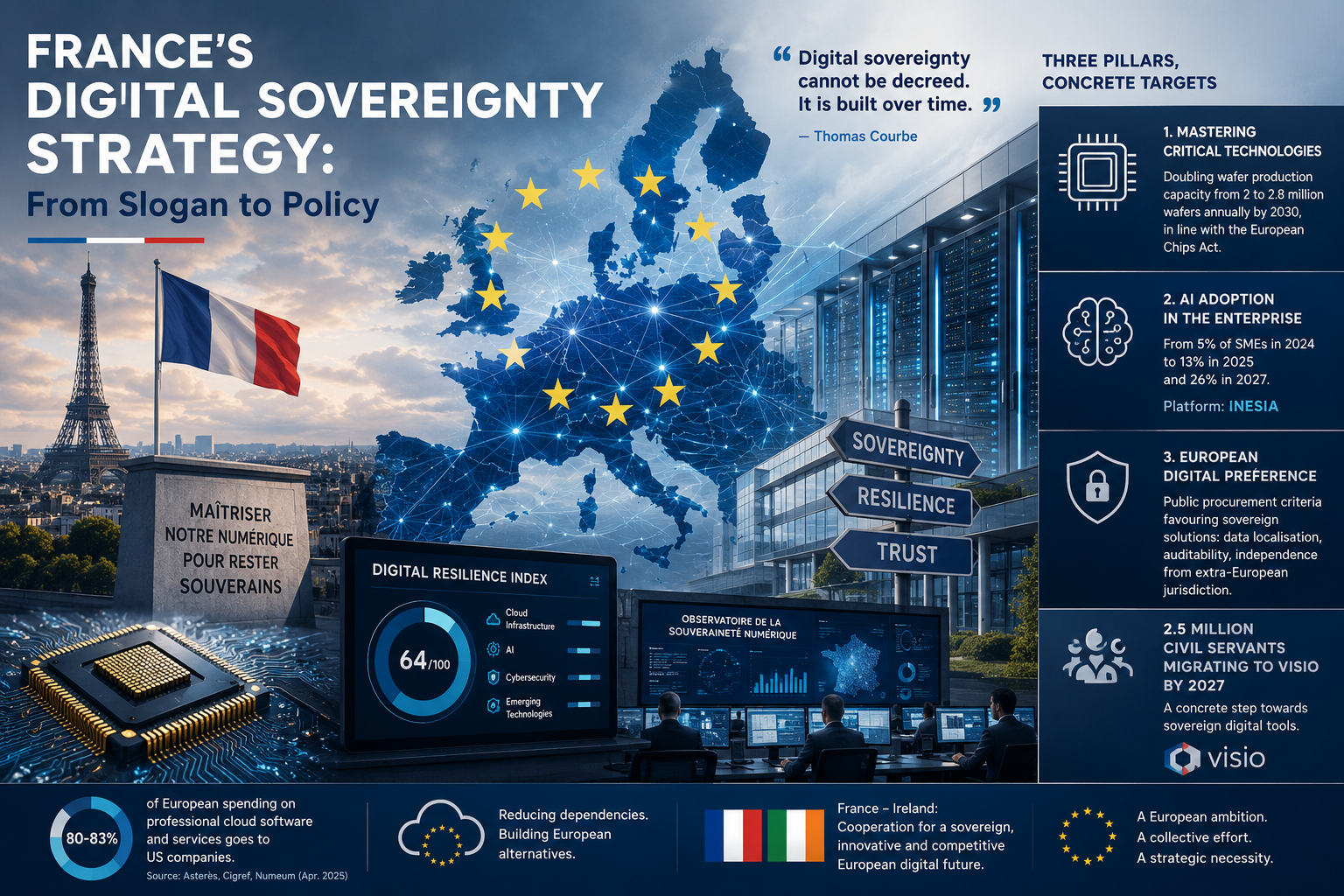

France's digital sovereignty strategy is moving from political slogan to operational policy. Thomas Courbe's essay in Réalités Industrielles maps three concrete pillars — and what they mean for Ireland and Franco-Irish digital cooperation.
In a recent essay published in the Revue Politique et Parlementaire, in a special issue on digital sovereignty coordinated by Thaima Samman, Thomas Courbe, Director General of Enterprises at the French Ministry of Economy, sets out with unusual clarity what France's strategy for digital sovereignty actually consists of, and what it will take to make it work. The piece is worth reading closely, not as a diplomatic statement but as a working document: three pillars, concrete metrics, identified gaps, and a candid acknowledgement that the task is far from finished.
What makes it particularly timely is the context in which it lands. Over the first months of 2026, French digital sovereignty moved from declared intent to operational policy with a velocity that surprised even close observers.
A Concept Given Teeth
For years, "digital sovereignty" functioned as a political rallying cry in France and across Europe: recognisable, persuasive, and sufficiently vague to unite very different agendas under the same banner. Thomas Courbe's article is, in part, an honest diagnosis of that problem. He notes that despite the concept's omnipresence in public debate, it has remained a fuzzy notion, lacking shared criteria.
The institutional response to that fuzziness is one of the article's most significant elements: the creation of a Digital Sovereignty Observatory (Observatoire de la souveraineté numérique), hosted by the High Commission for Strategy and Planning (HCSP) and led by former Europe Minister Clément Beaune. The Observatory's mandate is to publish regular statistics on France's dependencies on non-sovereign digital solutions, in effect a national dependency audit. Alongside this, a Digital Resilience Index (Indice de Résilience Numérique), with its first results expected in early 2026, will provide a structured measure of reliance on foreign digital services and products, covering cloud infrastructure, AI, cybersecurity, and emerging technologies.
The numbers behind this effort are stark. A study by Asterès commissioned by Cigref and Numeum in April 2025 estimated that 80 to 83% of European spending on professional cloud software and services flows to US companies, with an estimated €600 million in French public procurement going annually to US hyperscalers. These are the dependencies the Observatory is designed to track, and the strategy is designed to reduce.
Three Pillars, Concrete Metrics
Courbe organises France's sovereign digital strategy around three operational pillars, each with measurable targets that distinguish this document from its more declaratory predecessors.
The first pillar is mastering critical technologies, semiconductors above all. France committed to doubling its wafer production capacity from 2 to 2.8 million wafers annually by 2030, in alignment with the European Chips Act and its target of 20% global market share for Europe by the same date. This is the industrial infrastructure layer: without it, sovereignty in AI or cloud remains structurally dependent on hardware produced elsewhere.
The second pillar is AI adoption in the enterprise, where the metrics reveal the gap between policy intent and economic reality. In 2024, only 5% of French SMEs had integrated AI into their operations in any meaningful way. The strategy targets 13% by 2025 and 26% by 2027, an aggressive trajectory that relies heavily on the network of 575 AI Ambassadorsdeployed across France's economic regions and the 700 companies that have signed the Je choisis la French Techcommitment. The platform INESIA (Initiative Nationale pour l'Entreprise et la Société à l'Ère de l'IA), launched in 2025, is the operational vehicle for this transformation: a national AI platform designed to aggregate tools, training, and deployment support for companies at all stages of digital maturity.
The third pillar is European digital preference, arguably the most structurally ambitious and the most contentious. France has been pushing at the European level for public procurement criteria that favour solutions meeting defined sovereignty standards (data localisation, auditability, independence from extra-European legal jurisdiction). The Important Projects of Common European Interest (PIIEC) in cloud and semiconductors are the main instruments at EU level, but their scope remains contested and their implementation uneven. On the national side, the DINUM directive of April 2026, issued after Courbe's article was written, made the intent operational: each French ministry is now required to publish a plan for eliminating extra-European digital dependencies within defined timeframes. And the January 2026 announcement that the French state would migrate 2.5 million civil servants to Visio, a sovereign French videoconferencing platform, by 2027 is perhaps the most concrete single signal that the preference policy has moved from principle to procurement.
What This Means for Ireland
Ireland's position in the European digital landscape is distinctive, and the French strategy is worth reading from a Dublin perspective, not as a challenge but as a signal of where the European policy conversation is heading.
Ireland has built, over two decades, one of Europe's most dynamic digital economies. The concentration of major technology companies, data centres, and R&D operations, from cloud infrastructure to AI research, makes Ireland a significant node in the European digital ecosystem, and a country with genuine assets to contribute to any serious European sovereign digital project. Engineering talent, data centre capacity, research institutions with strong international partnerships: these are precisely the building blocks that European digital ambitions require.
The Digital Ireland 2030 strategy, published in February 2026, reflects many of the same priorities that Courbe articulates for France: AI deployment in enterprise, cybersecurity resilience, and next-generation digital infrastructure. The bilateral France–Ireland framework 2026–2030 explicitly includes digital sovereignty and cybersecurity as a priority axis, a recognition, on both sides, that these are domains where Franco-Irish cooperation has concrete and growing substance.
For Irish companies and research institutions, the acceleration of European digital sovereignty policy creates a relevant and evolving context. Any serious European effort to develop sovereign AI infrastructure, trusted cloud alternatives, and advanced cybersecurity capacity will need the kind of technical depth, proximity to EU institutions, and international connectivity that Ireland's ecosystem offers. The opportunity is real, and one that Irish and French actors are well positioned to explore together, through bilateral programmes, Horizon Europe consortia, and the growing network of institutional partnerships that both countries have invested in building.
A Credible Work in Progress
Thomas Courbe concludes with appropriate honesty: digital sovereignty cannot be decreed. It is built over time, with parliament, with European partners, and in close collaboration with the economic actors who are its primary architects: industrial ETIs, innovative SMEs, technology scale-ups. The foundations are being laid. The metrics are improving. The strategic intent has been translated, at least partially, into operational directives.
The harder question, one Courbe raises implicitly without resolving, is whether the pace of European construction is sufficient relative to the pace of dependency accumulation. Every year in which AI workloads scale on American cloud infrastructure is a year in which switching costs rise, vendor relationships deepen, and the option value of alternatives decreases. The G7 Digital Summit in Évian in June 2026, where France holds the presidency and will advance four priorities: AI safety, SME innovation, digital ecology, and online child protection. It will be a test of whether this agenda can build multilateral momentum or remains primarily national. of whether this agenda can build multilateral momentum or remains primarily national.
For now, the direction is clear. Whether it is fast enough is a different question.
This article draws on Thomas Courbe's essay "Maîtriser le numérique pour rester souverains : la stratégie française pour réduire nos dépendances," published in the Revue Politique et Parlementaire, (http://bit.ly/4wHwGBX) It is supplemented by reporting from Digital Watch Observatory (January 2026), The Next Web (January and April 2026), Inria (February 2026), the Atlantic Council (February 2026), and the official communiqués of the Franco-German Digital Sovereignty Summit (November 2025).