/
8 min read
France and Ireland: Two Innovation Models, One European Opportunity
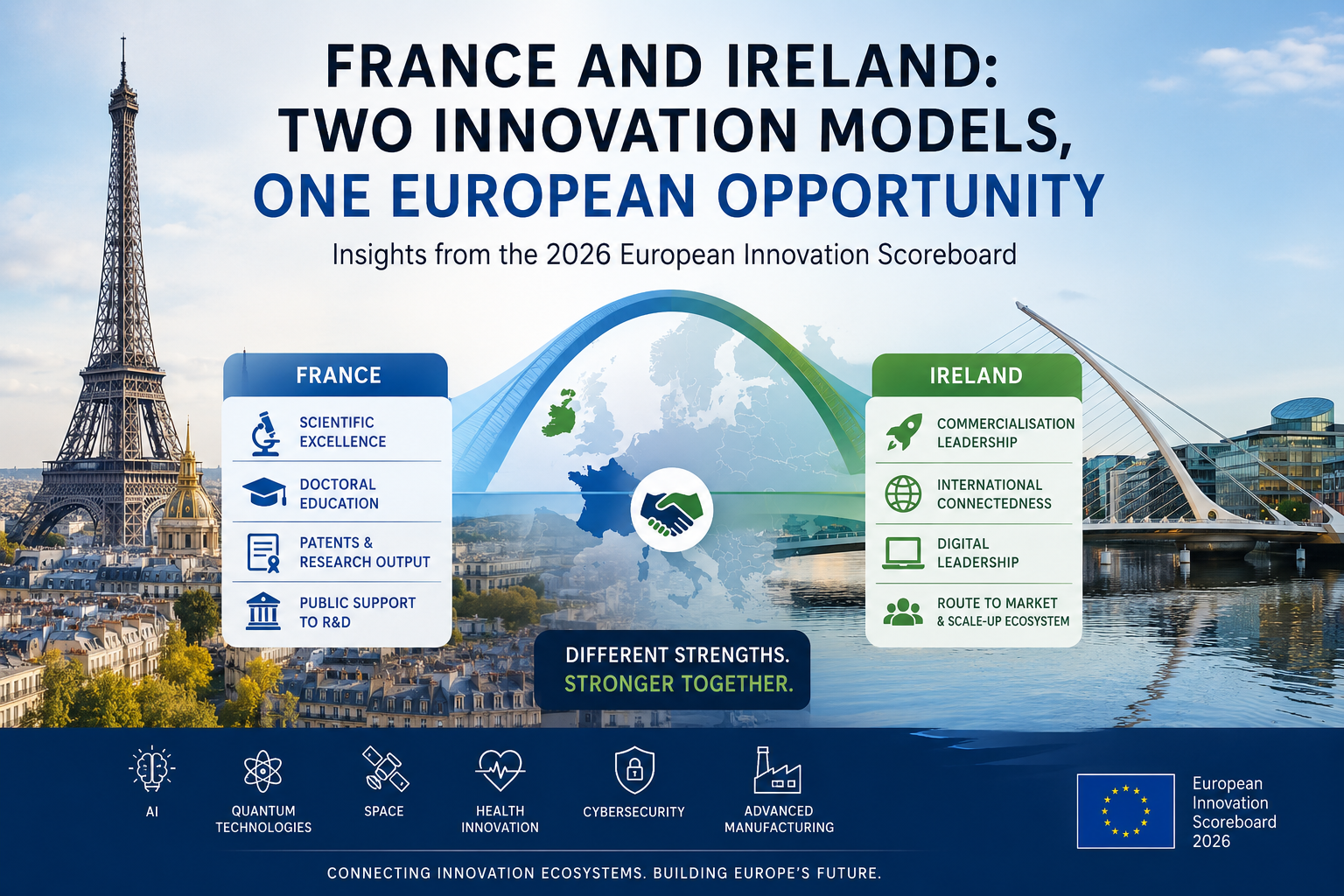
The 2026 European Innovation Scoreboard suggests that France and Ireland are not competing innovation systems. They may instead represent one of Europe's most complementary innovation partnerships.
Every year, the publication of the European Innovation Scoreboard (EIS) generates a familiar debate.
Who has climbed the rankings? Which countries are catching up with Europe's Innovation Leaders? Which national policies appear to be delivering results?
These questions matter, but they only tell part of the story.
At a time when Europe is trying simultaneously to strengthen its competitiveness, accelerate the commercialisation of deep technologies and reduce strategic dependencies, perhaps the more important question is no longer which Member State performs best. Rather, it is whether Europe's different innovation ecosystems are sufficiently connected to make the most of their respective strengths.
Innovation has never been a zero-sum game. Scientific discoveries, technological breakthroughs and industrial transformations increasingly emerge from networks rather than isolated national systems. Excellence remains essential, but excellence alone is rarely enough. Today's strategic technologies — artificial intelligence, quantum computing, biotechnology, space systems — require ecosystems capable of bringing together research, finance, entrepreneurship, industrial capacity and access to international markets. No single Member State, however well resourced, assembles all of these in equal measure.
From that perspective, the 2026 European Innovation Scoreboard offers a fascinating comparison between France and Ireland.
Both countries belong to the group of Strong Innovators. Ireland ranks sixth among EU Member States, with an innovation performance equivalent to 118.6% of the EU average, while France ranks tenth at 109.1%. Interestingly, both countries have progressed by almost exactly the same margin since 2019 — around eleven percentage points each.
At first sight, these figures suggest two countries following broadly similar trajectories. Reading the country reports in detail, however, reveals something far more interesting: France and Ireland have not become Strong Innovators by following the same path. They have specialised in different parts of the innovation chain. And that may be precisely where Europe's greatest opportunity lies.
Two innovation philosophies
One of the most striking aspects of the two reports is how frequently the strengths of one country correspond almost exactly to the weaknesses of the other.
France has built one of Europe's deepest scientific ecosystems. Its universities, grandes écoles, research organisations and public research agencies represent decades of sustained investment in knowledge production. Public policies such as the research tax credit (Crédit Impôt Recherche), the France 2030 investment plan and successive industrial strategies have reinforced a system capable of generating world-class science and engineering talent.
This becomes immediately visible in the Scoreboard. France ranks first in Europe for new doctorate graduates, first for direct and indirect public support to business R&D, and remains among Europe's better-placed countries for patent applications and venture capital investment. The foundations are unquestionably solid.
Ireland presents a very different picture. With a population of little more than five million, Ireland could never compete with France on the scale of research investment alone. Successive governments chose another strategy instead. Rather than trying to reproduce the large public research systems found elsewhere in Europe, Ireland concentrated on becoming one of the continent's most internationally connected innovation economies. The objective was never simply to produce knowledge — it was to build a place where knowledge could circulate, attract investment and generate economic value quickly.
That choice has shaped almost every dimension of today's Irish innovation ecosystem. The country combines internationally recognised universities, one of the world's highest concentrations of multinational technology and pharmaceutical companies, an agile innovation agency in Enterprise Ireland, a powerful inward-investment strategy led by IDA Ireland, and increasingly mature start-up and scale-up communities. Innovation therefore develops within an ecosystem where researchers, entrepreneurs, investors and global companies interact almost continuously — not as a matter of policy aspiration, but as the daily operating condition of the economy.
This structural difference explains many of the contrasts that run through the Scoreboard.
From laboratory to marketplace
Perhaps the clearest illustration concerns commercialisation.
Innovation policy often focuses on research expenditure, numbers of researchers, or patent production. These indicators, however, only describe the beginning of the innovation journey. The ultimate objective is the creation of new products, new services, new companies and, ultimately, new markets.
Here the contrast between France and Ireland becomes particularly revealing. France performs exceptionally well on many of the indicators traditionally associated with scientific excellence. Yet one of its weakest results concerns precisely the commercialisation of that excellence: sales generated by products that are new to the market remain among the lowest in the EU. Ireland, by contrast, ranks first in Europe on this same indicator.
This is not because Irish researchers are inherently more innovative, nor does it imply that France's research system is underperforming. It illustrates an often overlooked reality: research excellence and market excellence are related but fundamentally different capabilities. The first depends on scientific capacity. The second depends on entrepreneurial culture, technology transfer, access to finance, industrial partnerships, regulatory agility and international business networks — capabilities Ireland has spent decades deliberately building, in the same way France has spent decades building scientific depth.
Viewed together, the two systems look less like competitors than successive stages of the same innovation value chain — one optimised for discovery, the other for delivery.
The internationalisation advantage
The same logic appears in research collaboration.
One of Ireland's strongest performances concerns international scientific co-publications and the broader attractiveness of its research system — Ireland ranks among the EU's top performers on both. This reflects more than academic collaboration. It illustrates an innovation culture built around openness, in which international talent, multinational R&D centres and cross-border partnerships are not peripheral features but central to how the system functions.
France tells a more nuanced story. Its scientific quality remains extremely high — few countries can match the depth of its research institutions — but the Scoreboard points to weaker international collaboration than many comparable European countries, with international co-publications ranking well below the EU average.
This matters because European research funding itself has evolved. Framework Programmes have progressively shifted from funding excellent national teams towards supporting excellent international consortia. Horizon Europe increasingly rewards ecosystems capable of assembling complementary expertise across borders — and France, despite its co-publication weakness, remains one of the programme's largest beneficiaries in absolute terms, a sign that its scientific depth continues to command a central seat at the European table.
In that environment, Ireland's openness becomes an asset not only for Ireland but for its partners too. Equally, France's scientific depth becomes an asset for Ireland. This is European added value in its purest form: not two countries each trying to close their own gap in isolation, but two gaps that happen to be each other's solution.
Innovation needs different kinds of capital
The Scoreboard also reminds us that innovation cannot be reduced to research expenditure alone. Financial ecosystems matter. Policy instruments matter. Institutional cultures matter.
France remains Europe's leading country for public support to business R&D. Ireland, by contrast, continues to display one of the lowest levels of public R&D expenditure in the EU — its single largest structural weakness in the entire Scoreboard. Yet Ireland compensates through another mechanism: its innovation system attracts international capital, multinational R&D centres and entrepreneurial talent at a scale most European countries cannot replicate. More than half of Irish value added is generated by foreign-controlled enterprises, one of the highest proportions anywhere in Europe.
This figure is sometimes presented as a vulnerability — and it is, in the sense that it exposes the economy to firm- and sector-specific shocks. It can equally be read as an enormous innovation asset: it places Irish researchers, SMEs and start-ups in daily contact with global industrial leaders, in a way that few purely domestic research systems ever achieve.
France possesses a different kind of capital altogether. Its research organisations, engineering schools and industrial champions generate technologies at a scale few European countries can match, underpinned by a public financing architecture built for the long run. Again, the two models appear complementary rather than contradictory.
A shared blind spot
It would be too neat, however, to present this only as a story of perfectly matching strengths and weaknesses. On at least one indicator, France and Ireland share the same gap rather than compensating for each other's.
Both countries rank among the weakest in the EU on formal intellectual property — trademark and design applications in particular. It is a curious result for two economies that, on almost every other measure, are among Europe's more innovative. Part of the explanation, in both cases, is structural: intellectual property linked to resident multinationals is frequently registered and managed outside the country where the underlying innovation takes place, which understates the domestic indicators captured by the Scoreboard.
This matters for the argument, not against it. It is a reminder that complementarity is not automatic or total — some challenges are genuinely shared, and shared challenges are exactly the kind that benefit from being examined jointly rather than separately. A common reflection on why two structurally different, multinational-anchored economies both under-report formal IP would likely produce more useful insight than either country arriving at the question alone.
Beyond rankings: building European value chains
Perhaps this is the real lesson of the 2026 Scoreboard: Europe does not necessarily need twenty-seven countries attempting to excel at exactly the same things. Its competitiveness may instead depend on connecting national strengths more intelligently.
This is already happening. The recent coupling of Ireland's AI Factory Antenna to AI Factory France provides a useful illustration of the model: France contributes world-class computing infrastructure, scientific excellence and AI research capacity, while Ireland contributes an internationally connected digital ecosystem, industrial partnerships and strong adoption capabilities. Neither country is duplicating the other's investment; each is anchoring what it already does best.
The same pattern is increasingly visible in quantum technologies, cybersecurity, space, health technologies and advanced manufacturing. Rather than duplicating investment, both countries have an opportunity to specialise while remaining deeply interconnected — an approach entirely consistent with the diagnosis of the Draghi report on the future of European competitiveness, which argues that Europe must better integrate its fragmented innovation ecosystems if it wishes to compete with the United States and China on the technologies that will matter most over the next decade.
From bilateral cooperation to European competitiveness
Working at the interface of Enterprise Ireland, French research organisations, universities, innovation agencies and companies over the past several years has reinforced one conviction: the complementarities highlighted by the European Innovation Scoreboard are not theoretical. They are already visible in Horizon Europe consortia, in emerging collaborations in artificial intelligence, quantum technologies and space, and in the growing number of researchers, entrepreneurs, investors and public agencies from both countries choosing to work together rather than in parallel.
Community-level initiatives play a quieter but no less important role in this. La French Tech Dublin, for instance, exists precisely to make these connections tangible on a day-to-day basis — bringing together founders, researchers and investors from both ecosystems around the same table, rather than leaving complementarity as something visible only in statistical tables and ministerial communiqués.
The challenge today, in other words, is not to invent new complementarities. It is to scale the ones that already exist.
Conclusion
The 2026 European Innovation Scoreboard is often read as a ranking. It deserves to be read as a map — one showing where Europe's innovation capabilities are concentrated, and how differently structured national ecosystems can reinforce one another.
France and Ireland illustrate this particularly well. France excels at generating knowledge. Ireland excels at transforming knowledge into economic value. Neither model is sufficient on its own; both carry real structural weaknesses that show no sign of resolving themselves in isolation. Together, however, they form something increasingly valuable: a genuinely European innovation partnership capable of combining scientific depth, entrepreneurial agility and global market reach.
In an era where Europe's competitiveness will depend less on individual national champions than on the quality of the connections between them, that may well be the Scoreboard's most important message.
Further reading
- European Innovation Scoreboard 2026, full report and country profiles for France and Ireland — European Commission, Directorate-General for Research and Innovation: research-and-innovation.ec.europa.eu/statistics/performance-indicators/european-innovation-scoreboard_en
- Mario Draghi, The Future of European Competitiveness, September 2024: commission.europa.eu/topics/competitiveness/draghi-report_en