/
6 min read
Women, Tech and Power: Lessons from a Franco-Irish Dialogue on Entrepreneurship
How can innovation ecosystems become more inclusive while remaining engines of technological transformation?
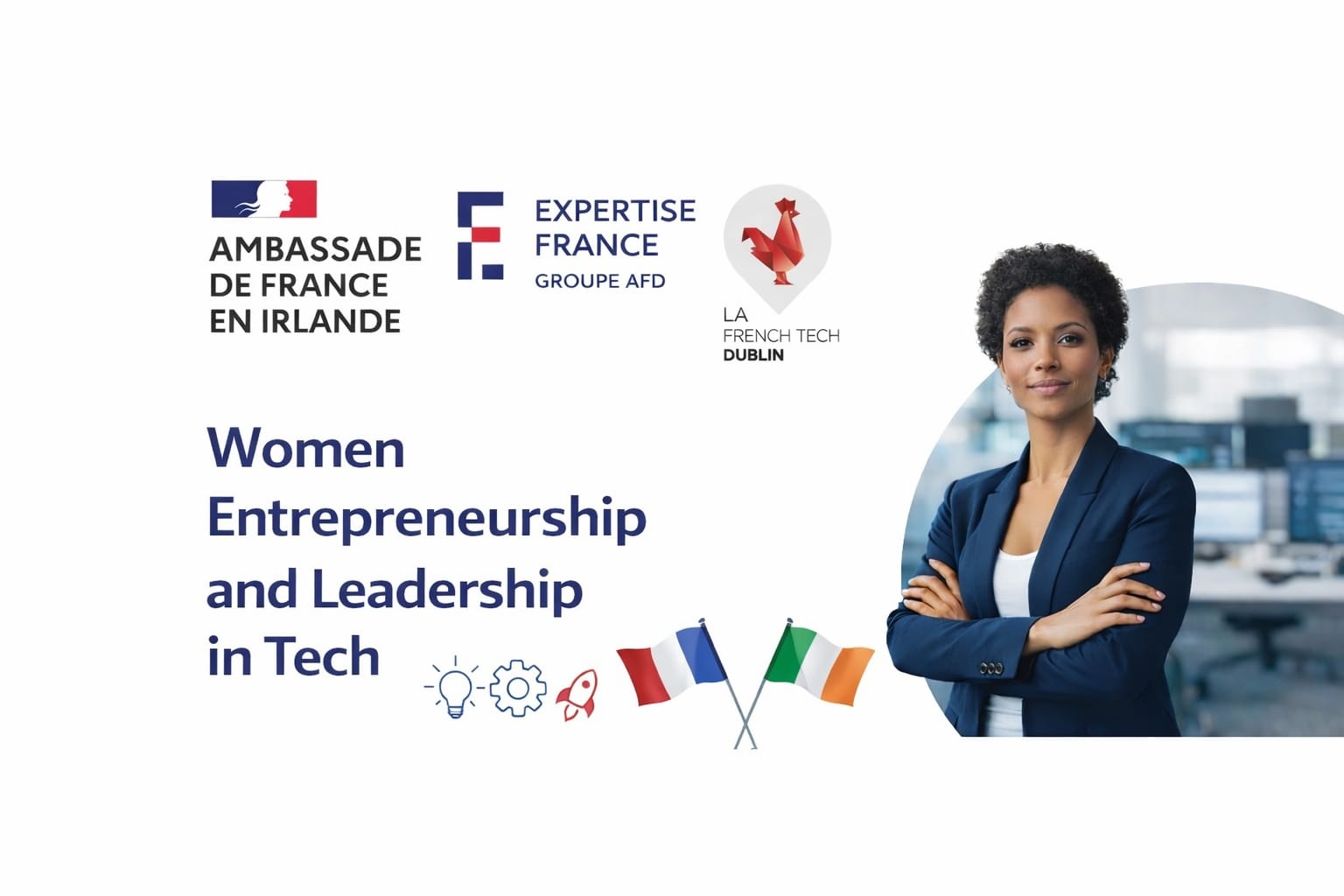
This question framed the roundtable “Women Entrepreneurship and Leadership in Tech”, hosted at the Résidence de France in Dublin and organised by the Embassy of France in Ireland, in partnership with Expertise France and French Tech Dublin.
Bringing together researchers, entrepreneurs and ecosystem actors from France and Ireland, the event explored a central challenge facing modern innovation systems: why women remain underrepresented in technology entrepreneurship and what this reveals about the structure of entrepreneurial ecosystems.
Rather than focusing solely on individual trajectories, the discussion examined how networks, investment dynamics and cultural narratives shape access to entrepreneurship.
Opening remarks: innovation, equality and international dialogue
Opening the evening, Ambassador Céline Place welcomed participants and placed the discussion within a broader international context.
Across the world, initiatives linked to International Women’s Day highlight women’s leadership in many sectors. However, the objective of this event was not simply commemorative. Instead, it sought to create a space for reflection on how innovation ecosystems themselves operate and how they can become more inclusive.
The Ambassador also recalled that these discussions resonate with France’s international feminist diplomacy strategy, which aims to promote gender equality across multiple domains, including economic participation, technological innovation and leadership.
Ensuring that women participate fully in technological innovation is therefore not only a matter of representation. It is also about who shapes the technologies that will influence our societies and economies in the decades ahead.
Within this perspective, the event also aimed to strengthen dialogue between France and Ireland, two countries with vibrant innovation ecosystems and strong research communities. Exchanges between entrepreneurs, researchers and institutions can help identify shared challenges and opportunities for cooperation.
Research perspective: understanding structural barriers in entrepreneurship
The keynote presentation was delivered by Stéphanie Eynaud, researcher at Université Jean Monnet Saint-Étienne, whose work focuses on gender and entrepreneurial ecosystems.
Drawing on academic research as well as her professional experience in startups and social initiatives, she explored several mechanisms that influence how women navigate entrepreneurial environments.
From the outset, she emphasised an essential point: women entrepreneurs are not a homogeneous group. Her research therefore does not attempt to represent all women founders, but rather to analyse how gender as a social category interacts with entrepreneurial ecosystems.
One of the most striking examples she presented concerns investor pitch dynamics.
Research shows that men and women founders tend to receive different types of questions when presenting their startups to investors.
Male entrepreneurs are more often asked promotion-oriented questions focused on growth and opportunity: how the company will scale, how it plans to expand internationally, or what its long-term vision might be.
Women entrepreneurs, by contrast, are more frequently asked prevention-oriented questions, centred on risks and potential failure.
“People do not gather before a pitch and say: ‘Let’s ask different questions to men and women.’ Yet we consistently observe that the questions are not the same.”
Although subtle, these differences can shape the entire dynamic of the conversation. When founders spend more time defending themselves against risks rather than presenting opportunities, the perception of confidence and ambition may shift.
Such dynamics help explain broader patterns observed in venture capital funding, where startups founded by women remain less likely to receive major investment.
Beyond investor behaviour, Stéphanie Eynaud also examined the role of networks within entrepreneurial ecosystems.
Entrepreneurial opportunities often emerge through informal exchanges: networking events, after-work gatherings, introductions between founders and investors. Strategic information frequently circulates through interpersonal relationships.
However, access to these networks is not always evenly distributed. Time constraints, family responsibilities or the persistence of “old boys’ networks” may limit participation in certain spaces where key connections are formed.
In this sense, networks function as an invisible infrastructure of opportunity within startup ecosystems.
Another dimension of the discussion concerned the importance of role models.
Successful women entrepreneurs can inspire future founders and help challenge stereotypes about leadership in technology. Yet because women founders remain fewer in number, the same individuals are often repeatedly highlighted.
Researchers sometimes refer to this phenomenon as tokenization, where a small number of individuals become visible representatives of an entire group.
Moving beyond these observations, Stéphanie Eynaud then introduced three major analytical approaches used in research on gender and entrepreneurship.
The liberal feminist approach focuses on removing barriers such as lack of access to funding or mentoring.
The social feminist approach emphasises differences in leadership styles and values between men and women.
However, both perspectives share a limitation: they attempt to adapt women to existing systems rather than questioning how those systems themselves operate.
This leads to a third perspective, the socio-constructivist approach, which analyses how gender norms and biases are embedded within institutions and organisational practices.
“Many solutions focus on fixing women rather than questioning how the system itself operates.”
Another powerful element shaping entrepreneurial culture is what she described as the myth of the entrepreneur.
Popular narratives often portray the entrepreneur as a heroic individual who succeeds entirely through personal effort — the famous figure of the self-made man.
Yet entrepreneurship is rarely an individual endeavour. It is deeply embedded within ecosystems composed of public policies, incubators, funding programmes and professional networks.
This myth can therefore reinforce a narrow image of who qualifies as a “real entrepreneur”.
For Stéphanie Eynaud, addressing inequalities in entrepreneurship therefore requires a broader reflection on ecosystem practices.
“Question your practices. Move beyond individual fixes and explore systemic improvements across the entrepreneurial ecosystem.”
Roundtable discussion: perspectives from the innovation ecosystem
Following the keynote presentation, the discussion continued with a roundtable moderated by Máirín Murray, founder of TechFoundHer.
The panel brought together perspectives from across the innovation ecosystem: Stéphanie Eynaud (Université Jean Monnet Saint-Étienne), Yvonne Galligan (Trinity College Dublin / Technological University Dublin), Sarah Walker (Enterprise Ireland), Lucie Loiseau (French Tech Dublin) and Fany Talagrand (Stripe).
Building on the structural dynamics presented during the keynote, the discussion explored how these challenges are experienced in practice across entrepreneurial and technological ecosystems.
One of the first themes to emerge was the relationship between diversity and the design of technology. Participants highlighted that technological systems are never entirely neutral. The perspectives, experiences and social backgrounds of those who design technologies influence the questions that are asked, the problems that are prioritised and the solutions that are ultimately developed.
In this context, diversity within entrepreneurial and technological communities becomes essential to ensure that innovation reflects a broad range of societal needs.
Fany Talagrand emphasised that diversity should not only be framed as a question of fairness or representation, but also as a strategic advantage for companies and investors.
“The second thing, which I think is not talked about enough, is the competitive advantage of diversity.”
Diverse teams, she noted, often bring different lived experiences that allow them to better understand markets and users, particularly in areas such as healthcare, safety or digital services.
The discussion also addressed the role of public institutions supporting entrepreneurship. From the perspective of Enterprise Ireland, Sarah Walker highlighted that progress has been made in recent years in increasing the share of early-stage funding going to women founders in Ireland. However, she also noted that an important challenge remains in the transition from early support programmes to venture capital investment, where access to networks and investor relationships becomes particularly decisive.
From an academic perspective, Yvonne Galligan stressed that many initiatives aimed at supporting women entrepreneurs still tend to focus primarily on individual behaviour rather than on structural dynamics.
“I am really fed up with solutions that say ‘fix the women.’”
Instead, she argued that greater attention should be given to examining the systems and institutional practices that shape entrepreneurial ecosystems and may unintentionally reproduce inequalities.
Lucie Loiseau also highlighted initiatives emerging from within the technology ecosystem itself. She referred in particular to programmes such as the Parity Pact, launched by the Mission French Tech, which encourages startups to commit to improving gender balance in governance, recruitment and leadership.
She also mentioned organisations such as SISTA, which aim to increase the number of women founders and improve their access to venture capital funding. Importantly, she emphasised that progress in this area requires the engagement of the entire ecosystem, including male allies.
As the discussion progressed, participants reflected more broadly on the environments within which entrepreneurship takes place. Rather than focusing exclusively on individual trajectories, the debate increasingly pointed to the importance of questioning the norms, networks and institutional practices that structure innovation ecosystems.
Reflecting on the exchanges, Máirín Murray challenged one of the most common narratives surrounding women in entrepreneurship.
“Women have no shortage of confidence.”
The real challenge, she suggested, lies in understanding how innovation ecosystems were historically structured and how they can evolve to become more inclusive.
In that sense, the discussion echoed a central idea running throughout the evening: the issue is not about fixing women, but about redesigning systems so that entrepreneurship can reflect the full diversity of talent within society.
Franco-Irish cooperation: building bridges between ecosystems
In the final part of the discussion, participants explored opportunities to strengthen Franco-Irish cooperation on these issues.
France and Ireland each bring complementary strengths to the European innovation landscape. France has developed strong public support mechanisms for innovation and entrepreneurship, while Ireland benefits from an open, international and highly connected technology ecosystem.
These complementarities create opportunities for deeper collaboration.
Participants mentioned several potential avenues, including mentoring programmes between French and Irish entrepreneurs, increased visibility for women founders across both ecosystems, and stronger connections between investor networks.
More broadly, the discussion highlighted the importance of continuing dialogue between researchers, policymakers, entrepreneurs and ecosystem organisations.
As technological transformation accelerates — particularly with the rise of artificial intelligence — ensuring that innovation ecosystems remain inclusive will require collective reflection and cooperation across countries and communities.
The evening therefore demonstrated not only the relevance of discussing gender and entrepreneurship, but also the value of Franco-Irish dialogue in shaping more inclusive innovation ecosystems for the future.