/
7 min read
Research Ireland 2026–2030: A New Chapter for Irish Innovation and European Research Cooperation
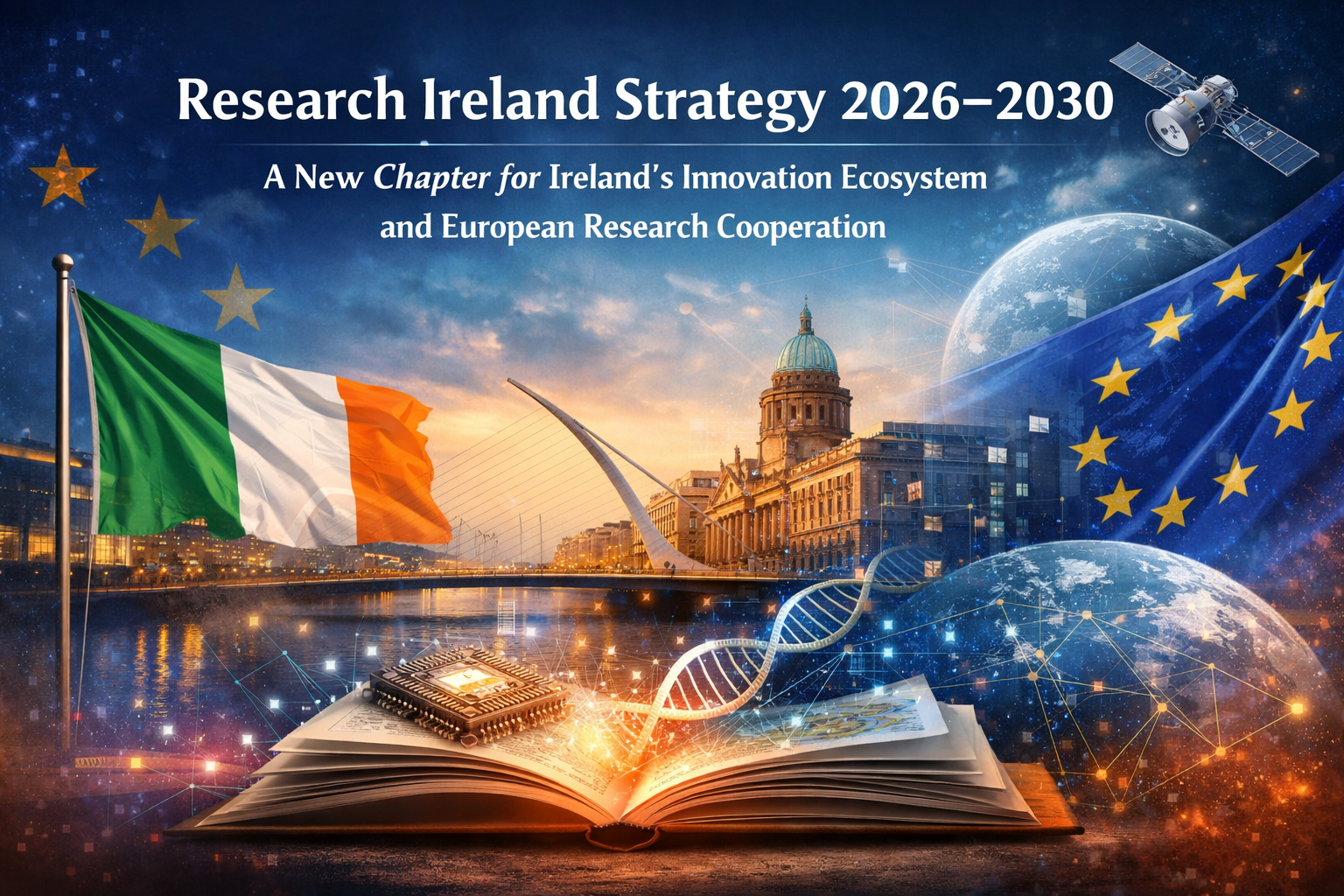
Research Ireland has just published its first-ever strategy. Behind the three words — Curiosity, Capability, Competitiveness — lies a €4.55bn investment plan, a new national supercomputer, and a direct institutional link between Irish and French AI infrastructures.
Research Ireland has just published its inaugural strategy. Curiosity, Capability, Competitiveness — Charting Ireland's Research and Innovation Future 2026–2030 — launched on 2 March 2026 in the presence of Taoiseach Micheál Martin — is the first strategic document of the national research funding agency since its creation. Three words to define the ambition of an institution that intends to position itself no longer as a mere funder, but as a genuine driver of transformation within Ireland's research and innovation system.
For France, this publication is far from incidental. It comes at a moment when Franco-Irish ties in research and innovation now rest on concrete infrastructure — from PHC Ulysses to AI Factories, via Horizon Europe — and as Ireland prepares to assume the Presidency of the Council of the European Union in 2026. Reason enough to read this strategy not as an Irish administrative document, but as a shared roadmap.
A Historic Investment, A Clear Ambition
The Research Ireland strategy sits within an unprecedented budgetary framework for the Irish research and higher education sector. In December 2025, the Irish Government published its five-year investment plan: €4.55 billion committed over the 2026–2030 period to support research, innovation and post-secondary education — the largest capital investment ever made by the Irish State in this sector.
Of this overall envelope, €1.4 billion is directed towards Research Ireland's competitive research funding programmes, and €2.45 billion is invested directly into research and innovation — equipment renewal, funding of new centres, and international collaborations. Another significant signal: €60 million is reserved for maintaining Ireland's membership of major international research organisations, including CERN. This level of budgetary commitment gives the Research Ireland strategy a concrete foundation that many strategic documents lack.
An Institution Changing Its Posture
Research Ireland currently supports more than 4,000 researchers and postgraduate students across Irish higher education institutions, while steering major national collaborative research platforms that connect academic teams with industry partners — from multinationals established on the island to the most recent startups in the local ecosystem. The scope is considerable. What changes with this strategy is the stated ambition to move from a grant-making logic to a transformation logic.
Research Ireland's CEO, Dr Diarmuid O'Brien, embodies this shift. A former pro-vice-chancellor for innovation at the University of Cambridge — and before that CEO of Cambridge Enterprise, following more than fifteen years at Trinity College Dublin where he was the institution's first chief innovation and enterprise officer — he returns to Ireland with a clear conviction: research and innovation have moved, for Ireland, from "nice-to-have" to "must-have". In an interview with SiliconRepublic, he positions Research Ireland as a critical national strategic asset, essential both for attracting foreign investment and for developing a domestic Irish industrial base — two priorities Ireland must pursue simultaneously if it is to sustain its growth trajectory in an uncertain European context.
For foreign actors — funding agencies, research organisations, companies seeking European partners — the strategy offers something concrete: identified priorities, a stable institutional interlocutor, and a five-year framework legible enough to build lasting partnerships around.
Three Pillars, Measurable Targets
The strategy is structured around three pillars — Talent, Economy, Society — reflecting a tension that Ireland openly assumes: funding scientific excellence while maintaining strong pressure for tangible economic and social returns.
On the Talent front, the targets are precise: training 3,800 doctoral students and 2,000 postdoctoral researchers over the period, funding 1,000 investigator-led projects, and attracting 29 internationally renowned researchers through dedicated recruitment fellowships. The Inspire initiative accompanies this pillar by funding significant modernisation of research infrastructures — cutting-edge equipment, experimental platforms, computing capacity. The ambition is to make Irish institutions structurally attractive to the best profiles, whether from Europe, North America or Asia.
On the Economy front, the targets are equally explicit: maintaining 14 research centres operating at international scale, reaching 50 active spin-outs founded by Research Ireland-funded researchers, and increasing industry co-participation — with a target of 36% co-funding from multinationals and 16% from SMEs.
On the Society front, the strategy plans to fund 150 projects in direct partnership with government departments, in a logic of public policy impact — health, energy, climate transition, regional cohesion. O'Brien makes it plain: beyond economic competitiveness, Research Ireland must help equip Ireland to face its collective challenges — AI and regulation, decarbonisation, housing, transformation of public services through data.
Ireland's Digital Ecosystem: Building Critical Mass
Digital technologies occupy a central place in the strategy. Ireland hosts one of Europe's densest digital ecosystems — European headquarters of major global platforms, a growing network of startups, and research centres with significant international standing.
Two platforms deserve particular attention. The ADAPT Research Centre, specialising in natural language technologies and AI, and the Insight Centre for Data Analytics, whose work in data science and trustworthy AI has gained considerable international visibility. These are not simply academic structures: they operate in network with dozens of industry partners and represent concrete entry points for external collaborations.
The 2026–2030 strategy anticipates a closer integration of these two major platforms in the coming months, in a logic of consolidation and critical mass. Combined with two other major developments — the arrival of CASPIr and the launch of the Irish AI Factory Antenna — this move sketches a national digital research infrastructure that is changing in both nature and scale.
CASPIr (Computational Analysis and Simulation Platform for Ireland) is Ireland's future national supercomputer, operated by the ICHEC (Irish Centre for High-End Computing) at the University of Galway. Co-funded by EuroHPC and the Irish Government, it is due to come into service in 2027. Its arrival will position Ireland among the 31 nodes of the European EuroHPC network, with capacities dedicated to digital twins, climate modelling, life sciences and advanced AI applications. The December 2025 government investment plan confirms this explicitly: development of the new high-performance computing system is being conducted jointly by the University of Galway and ICHEC.
What makes this development particularly significant from a Franco-Irish perspective is what accompanies it. Within the framework of the European AI Factories strategy — open-access hubs for AI computing power deployed around EuroHPC supercomputers — Ireland has obtained Antenna status, a satellite node connected to a principal AI Factory. The priority partner designated for the AIF IRL-Antenna is AI2F, the French AI Factory led by GENCI and Inria. This link inscribes within the European institutional architecture a Franco-Irish relationship that, until now, had relied largely on bilateral goodwill. The two platforms are expected to collaborate on access to computing resources, AI model development and the animation of national ecosystems of startups and technology SMEs.
The Tyndall National Institute, explicitly identified in the government plan as a national focal point for deep-tech research and doctoral training, completes this picture — particularly in semiconductors and photonic technologies where Ireland has developed world-class capabilities.
Franco-Irish Cooperation: Instruments and Sectors
The Franco-Irish research relationship has a toolkit that, taken as a whole, covers every level of maturity of a scientific partnership.
At the foundation sits the PHC Ulysses Programme — a straightforward bilateral instrument designed to connect French and Irish researchers. Short mobility grants, cross-laboratory visits, first co-publications: this is the tool of initiation, the one that creates the human conditions for collaboration before a joint project even exists. Modest in volume, it is strategic in its logic. Almost every Franco-Irish collaboration that has performed well within Horizon Europe began with this kind of exchange. Ulysses does not replace the major European programmes — it prepares them.
At the European level, Horizon Europe structures long-term partnerships, provides access to large-scale funding and connects Irish teams to shared major infrastructures — including, tomorrow, the computing capacity of AI Factories and EuroHPC supercomputers. And the operational link between the AIF IRL-Antenna and AI2F now inscribes this cooperation within the European institutional architecture itself.
Beyond these instruments, there are sectoral convergences between France and Ireland that deserve to be named.
Trustworthy AI and digital governance are probably the most fertile ground. Ireland hosts the European headquarters of many major global platforms, giving it a practical expertise on digital regulation challenges that few European countries possess to the same degree. France, with its work on algorithmic ethics and its active role in shaping the European AI regulatory framework, is a natural partner.
Quantum technologies represent another high-potential area. Quantum Ireland is actively seeking European partners for its work in quantum communication and computing. One example illustrates this potential: Equal1, a UCD spin-out, has developed the world's first portable quantum computing system on a single chip and is collaborating with NVIDIA. French capabilities in this domain — Télécom SudParis, CEA, industrial players — are directly complementary.
Semiconductors and deep-tech constitute a third area of convergence, directly linked to the role the Irish government assigns to Tyndall National Institute. In a geopolitical context that makes cooperation between European countries particularly strategic on critical technology value chains, the complementarities between the two ecosystems are real.
Marine renewable energies, finally: Ireland possesses one of Europe's largest offshore wind resources and is developing an industrial and research sector around it, with electrical interconnection challenges that directly concern France.
The Irish EU Presidency: A Moment to Anticipate
In 2026, Ireland assumes the rotating Presidency of the Council of the European Union. This timing falls at a particularly favourable moment: the Research Ireland strategy enters into force the same year, CASPIr is due the year after, and European discussions on AI governance, research data and the next multiannual financial framework will be reaching their point of tension.
A presidency gives a country enhanced capacity to steer debates on these cross-cutting issues. On AI governance at European scale, on the articulation between technological sovereignty and international openness, on science funding in the next multiannual budget — France and Ireland share interests close enough to build common positions and carry weight together in European debates.
It is also a moment when the visibility of Irish institutions will naturally increase. French actors seeking to strengthen their relationships with Ireland's research ecosystem would do well to anticipate this period and open dialogues now, ahead of an Irish agenda that will be very full by the second half of 2026.
A Natural Partnership, Still to Be Built
Ireland is not a large country. But it is deeply integrated into European and global networks, positioned in sectors where France has its own ambitions, and now equipped with a legible five-year research strategy, a national supercomputer in deployment, and a direct institutional link to the French AI Factory.
What changes with the Research Ireland 2026–2030 strategy — with its €4.55 billion of public investment, its 5,800 researchers to train, its 50 spin-outs to bring to life — is that the Franco-Irish relationship in research and innovation ceases to be purely a matter of bilateral goodwill. It now has infrastructure, a framework and a timeline. For European partners — and particularly for France — this is an invitation to act. The window is open.