Ireland’s Energy System in 2025 : A system under pressure, a European stress test and a mission-oriented framework for Franco-Irish cooperation
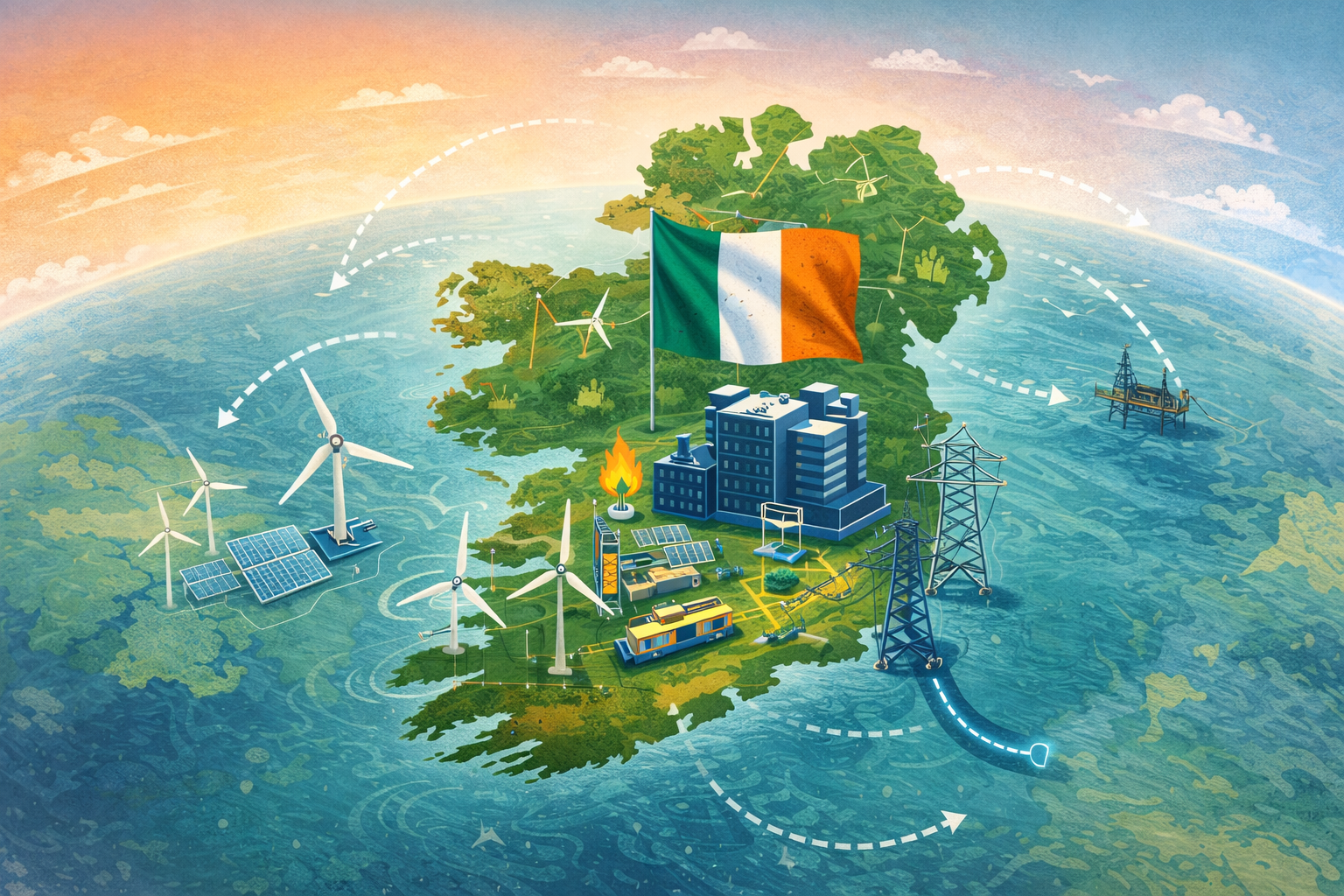

Ireland’s energy system is a European stress test. With 80% import dependency, rapid electrification, data centres driving demand and rising reliance on interconnection, Ireland shows how Europe’s energy transition is becoming operational, systemic and deeply interconnected.
The Energy in Ireland 2025 report published last December by the Sustainable Energy Authority of Ireland is more than an annual statistical update. It is one of the most complete and transparent system-level energy assessments currently available in Europe, capturing how electrification, climate policy, digitalisation and infrastructure constraints interact inside a real, operating energy system.
Ireland offers a particularly revealing vantage point on the European energy transition. As a small, open and highly interconnected economy, its energy system concentrates many of the tensions now emerging across the EU: high import dependency, rapid deployment of variable renewables, accelerating electricity demand, grid stress and growing reliance on cross-border infrastructure. In this sense, Ireland is less an exception than an early indicator of what Europe as a whole is moving toward.
An energy system still structurally exposed
Despite sustained progress over the past decade, Ireland remains one of the most import-dependent energy systems in the European Union. In 2024, 79.7% of Total Primary Energy Requirement (TPER) was met through imports, reflecting both the limited availability of indigenous fossil resources and the still incomplete penetration of renewable energy across all end-use sectors. Oil continued to dominate the energy mix, accounting for 48.9% of total energy supply, largely driven by transport demand, while natural gas represented around 29.7%, primarily imported through interconnection with the UK gas system.
Indigenous renewable energy sources, while expanding steadily, covered 14.6% of total primary energy needs in 2024. Their contribution remains highly concentrated in electricity generation, with significantly lower penetration in heat and transport. As a result, fossil fuels still represented 81.4% of Ireland’s total energy supply, underlining the scale of the structural transformation required to meet both climate objectives and long-term energy security goals.
This structural profile has direct implications for system vulnerability. High import dependency exposes Ireland’s energy system to external price volatility, supply disruptions and geopolitical risk, particularly in international oil and gas markets. The SEAI report explicitly links these characteristics to the strong policy emphasis placed on security of supply, diversification of sources and overall system resilience, alongside decarbonisation objectives. In this context, reducing emissions and reducing exposure are closely intertwined challenges rather than separate policy tracks.
As an island energy system with no indigenous oil or coal production and declining domestic gas resources, Ireland cannot rely on domestic extraction to manage these risks. Its transition pathway is therefore inseparable from European market integration, cross-border infrastructure and coordinated system planning. Increasing domestic renewable generation is a necessary condition, but not a sufficient one. Managing dependency also requires access to wider balancing areas, shared reserves and integrated markets capable of absorbing shocks and smoothing variability.
This structural exposure provides the backdrop against which the growing importance of interconnection must be understood.
Electricity: progress and pressure at the same time
Electricity is where decarbonisation progress has been most visible. In 2024, 41.3% of electricity consumption came from renewable sources, driven overwhelmingly by wind, which accounted for over 40% of gross electricity supply. Ireland now ranks among EU leaders for wind penetration, a notable achievement given the relatively small size and historically limited interconnection of its power system.
At the same time, electricity demand is rising rapidly and structurally. Total demand reached 32.9 TWh in 2024, an increase of 4.1% year-on-year, reflecting deeper economic transformation rather than short-term recovery effects. Data centres represented 21.2% of total electricity demand and accounted for 88.2% of demand growth since 2015, with consumption exceeding that of all Irish households combined.
These large, continuous and geographically concentrated loads are reshaping grid planning, generation adequacy and flexibility requirements, dynamics that are increasingly relevant across Europe as digital infrastructure expands.
Interconnection and system integration
As electrification accelerates, interconnection becomes a core component of system stability rather than a marginal optimisation tool. In Ireland’s case, the combination of high import dependency, rapid growth in variable renewable generation and structurally rising electricity demand has significantly increased reliance on cross-border exchanges. Existing interconnectors already play a substantial role in balancing supply and demand, providing access to additional generation capacity and flexibility resources. In some months of 2025, net electricity imports accounted for nearly a quarter of utility-scale electricity supply, underlining the degree to which system adequacy and operational security are now partly ensured beyond national borders.
This reliance reflects a broader transformation in how electricity systems operate under high-renewables conditions. As wind and solar penetration increases, system balance depends less on nationally available dispatchable generation and more on access to wider balancing areas. Interconnection enables surplus renewable electricity to be exported when local demand is saturated, while allowing imports during periods of low renewable output or peak demand. In doing so, it reduces curtailment, enhances resilience and lowers overall system costs.
Ireland’s experience mirrors a wider European trend. Several countries with high shares of variable renewables or limited domestic flexibility increasingly depend on cross-border exchanges to maintain system balance. In this context, interconnection is no longer an auxiliary asset added at the margins of national systems, but a foundational element of system design, contributing simultaneously to security of supply, flexibility and market efficiency in high-renewables electricity systems.
Heat and transport: the harder parts of the transition
Outside electricity, the scale of the challenge remains significant. Heat accounted for 35.1% of total final energy demand in 2024, with 89.8% supplied by fossil fuels. Residential heat demand alone reached 22.3 TWh, driven by population growth and housing expansion. While renewable heat increased by 5.6% and heat pumps now deliver more renewable energy than solar PV, progress remains constrained by retrofit rates, skills shortages and affordability issues.
Transport remains the largest source of energy-related emissions. In 2024, it accounted for 42.3% of Ireland’s total energy demand, dominated by road transport and dispersed settlement patterns. 93% of transport energy continued to come from fossil fuels, underlining the scale of the decarbonisation challenge. While renewable fuels contribute to emissions reduction, electrification, modal shift and demand reduction will be far more decisive over the coming decade.
Emissions and system balance
Ireland’s energy-related greenhouse gas emissions fell to their lowest level in over 30 years, standing 16% below 2018 levels, largely due to progress in electricity generation. Electricity alone delivered a 32% reduction in emissions since 2018. However, current trajectories remain insufficient to meet legally binding carbon budgets, as progress in electricity is not yet matched in heat and transport. This creates the risk of an increasingly asymmetric transition, where system imbalances become more pronounced over time.
Enabling technologies: the hidden backbone
Grid reinforcement, power electronics, digital monitoring, forecasting, modelling, flexibility mechanisms, storage and demand response form the hidden backbone of the transition. The combination of offshore renewables and large digital electricity users reinforces the need for system intelligence, making the energy transition as much a digital and engineering challenge as a generation one.
Cooperation frameworks: from European integration to Franco-Irish implementation
The dynamics described throughout the Energy in Ireland 2025 report underline a broader transformation in how energy cooperation operates in Europe. As systems become more electrified, digitalised and constrained, cooperation between Member States moves from strategic alignment to operational integration. Shared infrastructure, coordinated planning, aligned market rules and joint learning from real-world system operation become central to resilience.
Within this European framework, Franco-Irish cooperation plays a specific and concrete role. The most visible expression of this cooperation is the Celtic Interconnector, currently under construction between Ireland and France. With a 700 MW bi-directional capacity, it will be Ireland’s first direct electrical link with continental Europe. Beyond its contribution to security of supply and renewable integration, it creates a shared operational ecosystem involving transmission system operators, regulators, technology providers and researchers, particularly around system operation in high-renewables environments.
Cooperation also extends beyond physical infrastructure. Grid digitalisation, system modelling, forecasting, flexibility mechanisms and large-user integration are increasingly shared areas of interest, where operational experience gained in Ireland feeds into broader European system learning. Alongside electricity systems, hydrogen cooperation follows a distinct but complementary track, structured through a dedicated bilateral Memorandum of Understanding and aligned with evolving European hydrogen strategies.
Ireland as a European energy laboratory
Taken as a whole, Energy in Ireland 2025 portrays a system under intense pressure, but also one characterised by transparency, data quality and openness to cooperation. Ireland concentrates, within a single national system, many of the challenges Europe faces collectively: rapid electrification, digital demand growth, infrastructure constraints and reliance on cross-border solutions.
In this sense, Ireland functions as a European energy laboratory, where system-level solutions are tested in real operating conditions. Its energy transition is not only a national challenge, but a concrete testing ground for building Europe’s next-generation energy systems together.