France’s Energy Roadmap 2026–2035: Strategic Orientation, Technology Choices and European Outlook
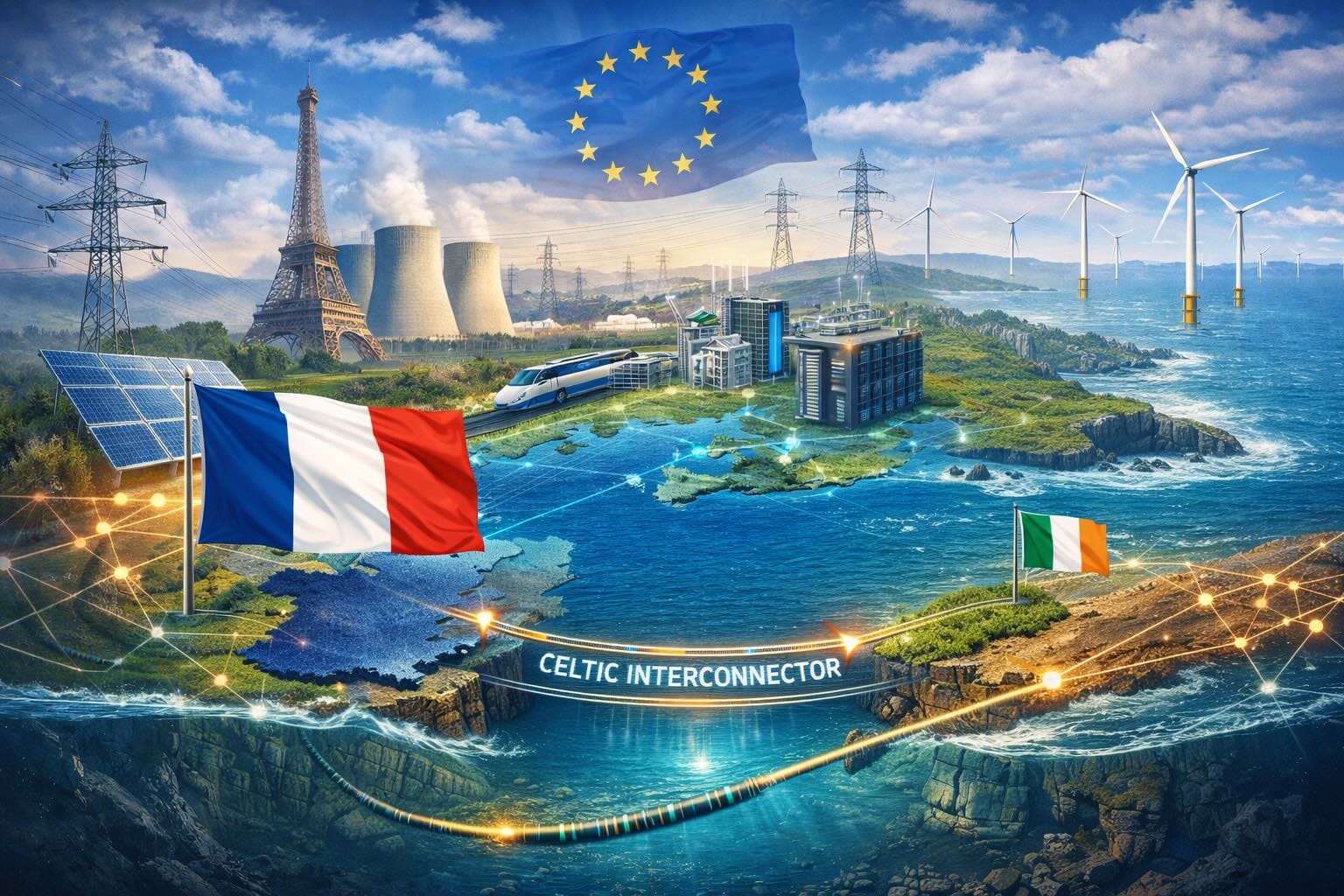

France’s 2026–2035 energy roadmap sets a clear course: scaling up low-carbon electricity, relying on nuclear and renewables, strengthening grids and flexibility, and anchoring the transition within an increasingly integrated European energy system.
1. A national energy roadmap built on scale, electrification and long-term visibility
Published in February 2026, France’s third Programmation pluriannuelle de l’énergie (PPE3) defines the country’s energy strategy for the period 2026–2035. The document sets out a clear and quantified trajectory aimed at strengthening energy sovereignty, accelerating decarbonisation and maintaining competitive energy prices in a context marked by geopolitical tensions, climate commitments and rising electricity demand. At its core, the roadmap assumes that electricity will become the central vector of the energy system and that large-scale electrification of uses is a necessary condition for reducing fossil fuel dependence .
The PPE3 plans a substantial increase in decarbonised electricity production, from around 458 TWh in 2023 to between 650 and 693 TWh by 2035. This increase is designed to support the electrification of industry, buildings, transport and, increasingly, digital infrastructure. Over the same period, France aims to reduce the share of fossil fuels in final energy consumption from nearly 60% today to around 40% by 2030, while increasing the share of decarbonised energy to around 70% by 2035. These objectives are aligned with France’s climate commitments and with broader European decarbonisation trajectories.
Nuclear energy plays a central role in this strategy. The PPE3 confirms the optimisation and lifetime extension of the existing nuclear fleet, with production expected to reach between 380 and 420 TWh by 2030, compared with around 320 TWh in 2023. It also confirms the construction of six EPR2 reactors and foresees a decision by 2026 on possible additional units. Alongside nuclear, the roadmap sets ambitious but adjusted targets for renewable electricity, including offshore wind (15 GW by 2035), onshore wind (35–40 GW by 2035, primarily through repowering), solar photovoltaics (55–80 GW by 2035) and hydropower, including pumped-storage capacity. Non-electric decarbonised energy vectors are also addressed, with targets for renewable and recovered heat, biomethane and low-carbon hydrogen.
Overall, the first function of the PPE3 is to provide a stable, long-term framework for the transformation of the French energy system, combining generation, electrification of uses and progressive exit from fossil fuels.
2. Technology and system integration at the heart of implementation
While the PPE3 is primarily an energy planning document, its implementation relies heavily on technological choices and system integration. A key message of the roadmap is that the main challenge of the transition is no longer the availability of low-carbon generation technologies, but the ability to integrate them efficiently into a reliable and resilient system.
This is particularly visible in the treatment of the electricity grid. The PPE3 highlights the need for major investments in networks to accommodate new generation capacity, electrified uses and changing consumption patterns. RTE’s forthcoming ten-year grid development plan foresees around €100 billion of investment over fifteen years to renew infrastructure, adapt the network to climate impacts, reinforce high- and very-high-voltage lines and connect new production sites. Flexibility mechanisms, capacity markets and dispatch rules are to be reformed in order to manage variability, price volatility and peak demand.
Digital technologies are implicitly central to this system transformation. Forecasting, optimisation, real-time control of production and demand, cybersecurity and data management are all necessary to operate a highly electrified and increasingly variable system. The roadmap also recognises the growing importance of electricity demand from the digital sector itself, including data centres and computing infrastructure, by explicitly including “digital” as one of the four pillars of the national electrification initiative to be launched from 2026.
On the production side, the technological dimension is equally present. Nuclear new build and lifetime extension rely on advanced engineering, safety systems and modelling tools. Offshore wind, hydropower optimisation, large-scale solar deployment and hydrogen production all require continued innovation to reduce costs, improve performance and integrate with industrial users. The PPE3 does not position innovation as an end in itself, but as a practical enabler of system reliability, cost control and industrial deployment.
3. European interconnections, cooperation and implications for Ireland
Although national in scope, France’s 2026–2035 energy roadmap is explicitly framed within a European context. Its objectives are aligned with EU climate targets, and its implementation increasingly reflects European regulatory, industrial and resilience frameworks, including cybersecurity and European value-chain criteria in energy tenders. In this perspective, energy sovereignty is not understood as national self-sufficiency, but as the reduction of strategic dependencies and the strengthening of European industrial and technological capabilities.
The roadmap assumes continued operation within a deeply interconnected European electricity system. Cross-border exchanges, balancing and system resilience are integral to the French strategy, particularly as electrification accelerates and variable generation expands. In this context, the Celtic Interconnector between France and Ireland stands out as a concrete embodiment of this European logic. While not a central policy instrument of the roadmap, it directly supports its objectives by enhancing security of supply, system flexibility and price convergence, and by reinforcing electricity markets as a shared European infrastructure.
For Ireland, these choices have tangible implications. The scale of French investment in low-carbon generation and grid reinforcement contributes to the stability of the wider North-West European power system. As Ireland faces sustained growth in electricity demand, notably driven by data centres and digital services, stronger interconnection with neighbouring systems becomes increasingly strategic. The French focus on network resilience, flexibility mechanisms and digital system management closely mirrors challenges faced by the Irish system, creating clear areas for technical and regulatory alignment.
The roadmap’s pragmatic approach to hydrogen and other emerging technologies also leaves room for cooperation. By linking deployment to industrial demand and system readiness, it favours coordinated European development over fragmented national initiatives. More broadly, France’s long-term visibility on energy priorities provides Irish stakeholders with a clearer framework for cooperation in areas such as networks, system integration, digital energy solutions and industrial decarbonisation.
Taken together, France’s 2026–2035 energy roadmap can be read not only as a national strategy, but as a structured contribution to Europe’s collective effort to combine decarbonisation, system reliability and industrial sovereignty. For Ireland, the Celtic Interconnector is a key interface within this vision, anchoring bilateral cooperation in an increasingly integrated European energy system.