/
4 min read
France–Ireland 2026–2030: Research and Innovation as Structuring Pillars of a Renewed Bilateral Framework
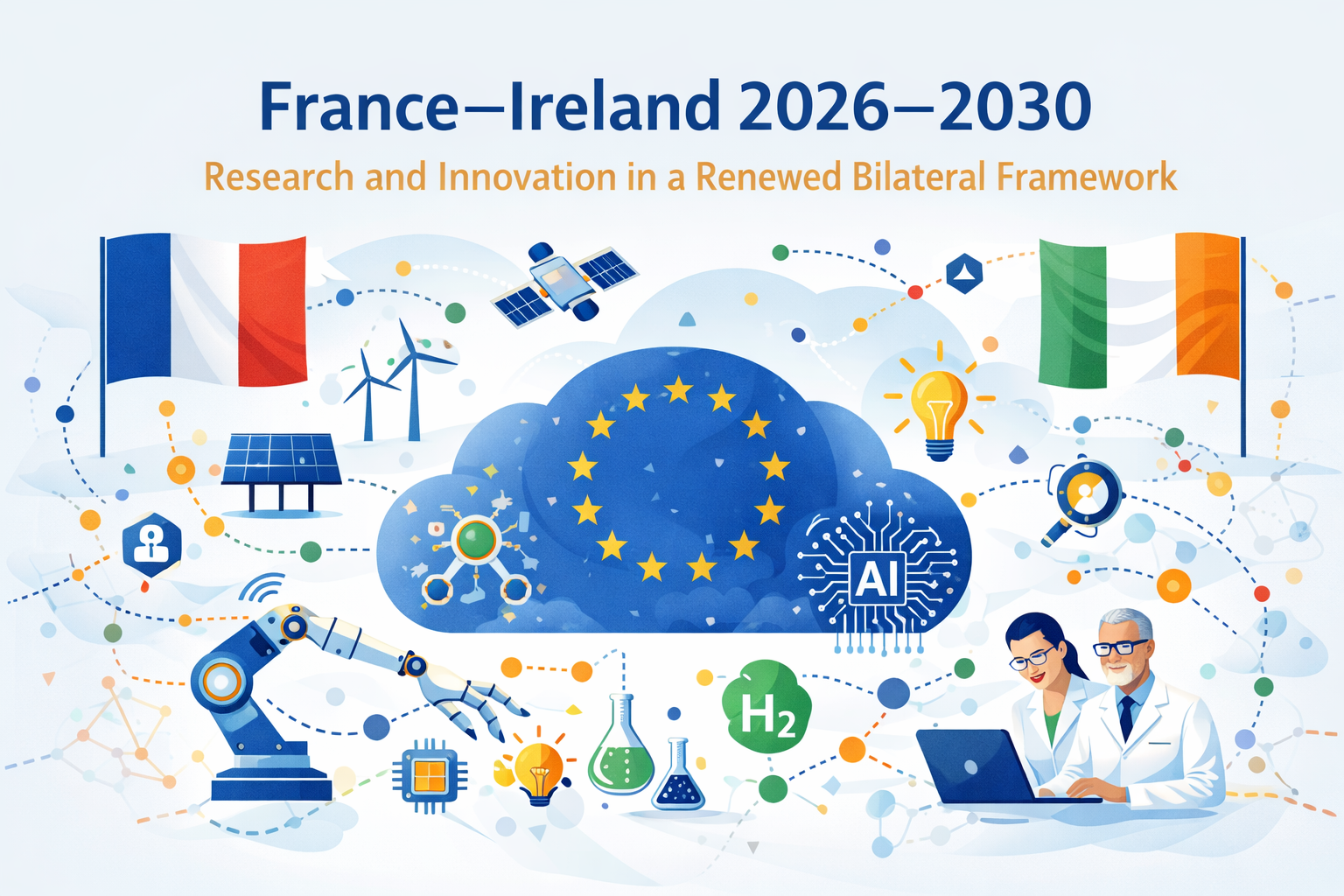
France and Ireland have renewed their strategic partnership for 2026–2030. This article explores how research and innovation are positioned as structuring pillars of the framework, shaping long-term Franco-Irish cooperation within a European context.
France and Ireland have renewed their bilateral partnership with the signing, on 28 January, of the France–Ireland Joint Strategic Framework 2026–2030.
The framework sets out a comprehensive agenda spanning diplomacy, security, energy, education, culture and economic cooperation. Within this broad scope, research and innovation occupy a clearly articulated and structured place, reflecting both their long-standing role in Franco-Irish relations and their growing strategic relevance in a European context marked by technological competition and systemic transitions.
Rather than attempting to cover the full breadth of the agreement, this article focuses on the elements that directly concern research cooperation, innovation systems and technological collaboration, as they are explicitly framed in the Strategic Framework and its accompanying Joint Action Plan.
Research cooperation as a long-term, structured commitment
The framework confirms that research and higher education cooperation remains a cornerstone of the Franco-Irish relationship. This cooperation is explicitly anchored in European-level instruments, reinforcing the idea that bilateral action and European integration are mutually reinforcing rather than competing approaches.
The emphasis on participation in European funding programmes, bilateral schemes such as Ulysses, and structured academic cooperation — including joint degrees, joint PhDs, researcher mobility and scholarships — points to a shared preference for durable mechanisms over ad hoc initiatives.
What stands out is not the introduction of new tools, but the reaffirmation of institutional continuity: sustained cooperation between universities, long-term researcher mobility, and progressive alignment of research agendas within European frameworks such as European University Alliances and Erasmus+.
For research organisations, this provides a stable environment in which Franco-Irish cooperation can be embedded into multi-year institutional strategies, rather than treated as a series of isolated projects.
Innovation framed as system alignment, not programme multiplication
Innovation is addressed throughout the framework as a transversal dimension, closely linked to research, industrial policy and competitiveness.
The agreement does not propose new innovation instruments or dedicated bilateral programmes. Instead, it prioritises alignment: alignment between national innovation systems, alignment with European strategic priorities, and alignment between research, industrial policy and regulatory environments.
This emphasis on alignment is also reflected in the framework’s explicit encouragement of closer cooperation between public trade, investment and enterprise agencies, including Business France, Enterprise Ireland and IDA Ireland, with the objective of strengthening bilateral cooperation and cross-border engagement within a deepened European single market.
Rather than adding layers of governance, the framework builds on existing mandates and complementarities, seeking to improve coherence and impact across already established instruments.
Digital technologies and AI: infrastructure as an enabler of innovation
Digital technologies — and artificial intelligence in particular — are explicitly highlighted in the Joint Action Plan. The reference to enhanced collaboration between French and Irish digital ecosystems, including cooperation around AI Factory Antennas, reflects a shared understanding that innovation capacity increasingly depends on access to infrastructure.
This framing goes beyond skills or software. It recognises that advanced research and innovation in data- and compute-intensive fields require access to computing resources, interoperable digital infrastructures, and coordinated ecosystem-level approaches.
By addressing digital cooperation at this level, the framework aligns Franco-Irish collaboration with broader European efforts to strengthen technological capacity and reduce structural dependencies, without prescribing specific technical solutions.
Ecosystem connectivity and mobility of talent
The framework approaches innovation ecosystems primarily through connectivity and mobility, rather than through prescriptive entrepreneurial policies.
Within the Joint Action Plan 2026–2027, France and Ireland express their intention to organise a targeted event to strengthen links between innovation ecosystems and to facilitate the movement of entrepreneurs and engineers. These measures complement research cooperation by recognising the importance of human capital circulation and network effects.
Entrepreneurial and innovation activity is thus treated as embedded within broader research and innovation environments, supported by institutional cooperation, talent mobility and ecosystem interaction rather than standalone start-up policies.
Energy, climate and applied research collaboration
Research and innovation related to low-carbon energy technologies form another important strand of cooperation. Offshore wind, hydrogen and energy systems are addressed as areas requiring sustained research and innovation effort, closely linked to infrastructure development and policy coordination.
These domains illustrate how the framework connects research cooperation with long-term policy objectives, recognising the importance of applied research, demonstration activities and knowledge exchange in sectors characterised by long development cycles and high capital intensity.
From strategic framework to operational continuity
The Joint Strategic Framework is accompanied by a Joint Action Plan for 2026–2027, which provides an operational layer and establishes mechanisms for regular review at ministerial level.
For research and innovation actors, this combination of strategic orientation and short-term action planning offers visibility on political priorities, continuity across policy cycles, and a clear reference framework against which projects and partnerships can be positioned.
Rather than creating new structures, the framework relies on enhanced coordination between existing institutions and instruments to translate strategic priorities into concrete cooperation on the ground.
Conclusion
The France–Ireland Joint Strategic Framework 2026–2030 confirms that research and innovation are not ancillary aspects of the bilateral relationship, but structuring components embedded within a broader European vision.
By prioritising alignment, institutional cooperation and ecosystem connectivity, the framework provides a coherent and credible environment for research and innovation collaboration. It reinforces existing trajectories while situating them firmly within European priorities and long-term technological transitions.
For universities, research organisations, innovation agencies and policy actors, it serves as a strategic reference point, enabling Franco-Irish collaboration to be positioned within European priorities while remaining grounded in existing capacities and instruments.
I am glad to take part in this journey and to contribute, from the ground, to the development of this Franco-Irish research and innovation partnership — both through my role as an International Technical Expert (ETI) and through my engagement within the French Tech Dublin ecosystem.